How to track your personal finances and not quit in a month
People do not quit tracking their finances because it is useless. They quit because they start with too much detail.
In short
To track your personal finances, record each expense right away or the same evening, use ten to twelve categories rather than fifty, add every account and your cash so the balance matches reality, and once a month spend fifteen minutes on the totals. Recording changes nothing on its own — what changes things is the decision you make after looking at the month.
Keeping track of your money sounds like something for tidy people with spreadsheets. In practice it is five minutes a day and one habit: recording the expense while you still remember how much and what for.
Three rules that hold it together
Right away
When to record
From memory at night, a third goes missing
10–12
How many categories
More never get filled, fewer explain nothing
Every account
What to add
Cards, cash, savings — so the balance matches
Record right away
The most common reason tracking stops working: expenses get entered in the evening or at the weekend. By then the small ones are forgotten, the totals do not match the card, and the whole thing feels pointless. Recording takes a few seconds if you do it at the till.
Few categories
Fifty categories look precise, but within a week you will not know where the coffee at the station goes. Ten to twelve are enough: housing, groceries, eating out, transport, phone and subscriptions, health, clothes, kids, fun, gifts, other. Add subcategories only where you really want detail.
All the money, not just the card
Tracking that leaves out the cash or the second card shows only part of the picture. Add every account and check once a week whether the balance matches the real one. If it does not, an expense is missing. How to track cash: tracking cash spending. If your money is in two currencies: tracking spending in two currencies.
Spreadsheet or app
A spreadsheet is free and flexible, but entering spending into it at the till is awkward, and most spreadsheets get filled in once a week — with gaps. An app is easier for daily entries; a spreadsheet for one-off calculations. The full comparison: spreadsheet or app for your budget. If you choose an app: how to choose a spending app.
After a month: what to look at
Totals by category
Where the most went
Rarely where you thought
Essential and the rest
Which share is flexible
That is the part you can work with
Against last month
Shares, not amounts
A share survives price rises
The first month of tracking is not a budget, it is observation. Change nothing, just record. At the end of the month look at where the money went — that is the answer to the question you started with. How to review the month in fifteen minutes: monthly review. What to do next: how to make a personal budget.
If you stopped
Do not restart from last month or try to rebuild what you missed. Start today and reset the balances of your accounts. Two missed weeks spoil nothing; trying to rebuild them spoils the will to carry on.
What it looks like in the app
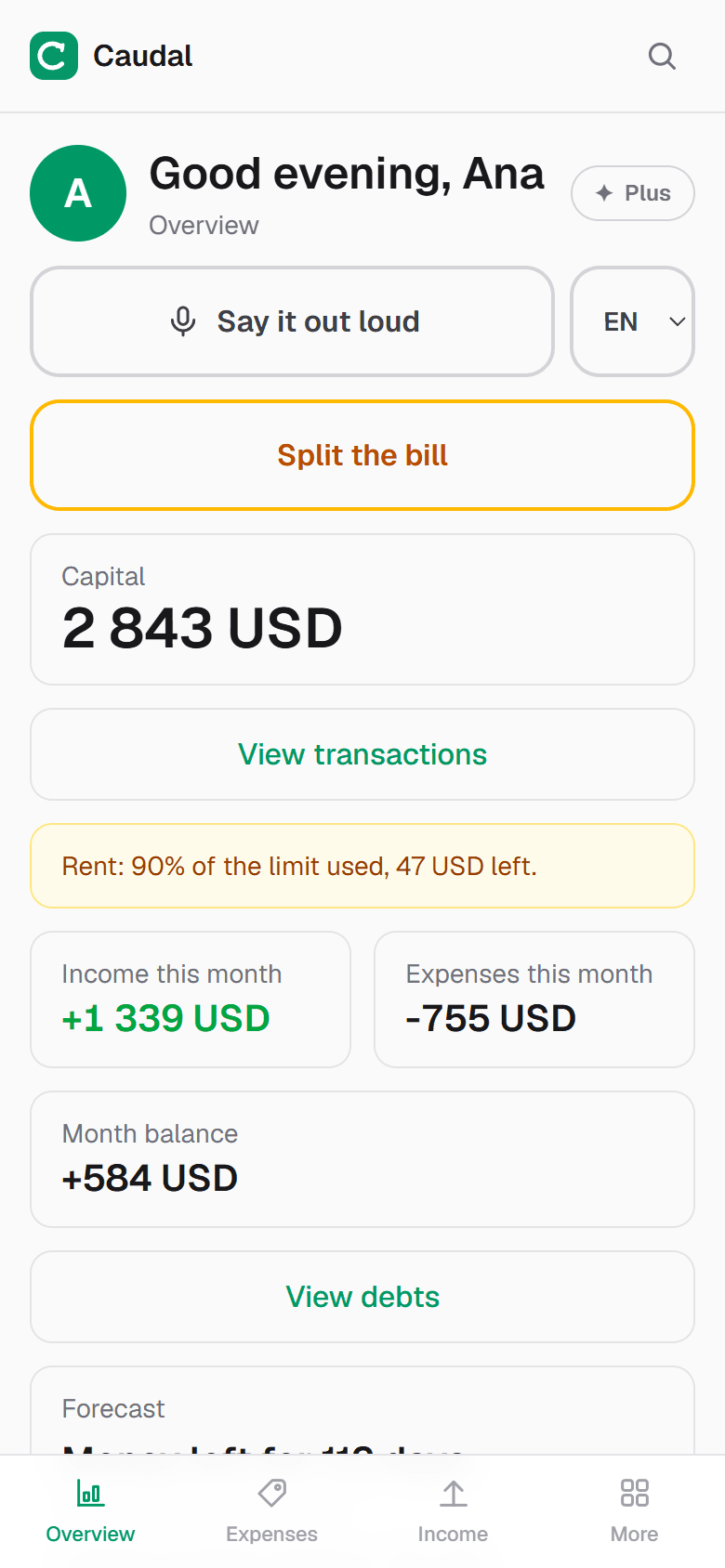
In Caudal recording an expense takes two taps: the category and the amount. You can also say it — "two hundred groceries" — and the app picks out the amount and the category. Accounts can be in any currency, and cash is just another account. The main screen shows how many days your money will last at the current pace of spending, and the reports show totals by category and how this month compares with earlier ones. No bank connection needed.
Common questions
- Where do I start tracking my personal finances?
- Add every account and your cash with today's balance, choose ten to twelve categories and start recording each expense straight after paying. In the first month change nothing — just observe.
- Is a spreadsheet or an app better for tracking expenses?
- For daily entries an app is easier: you can record the expense at the till in seconds. A spreadsheet suits plans and one-off calculations, but it usually gets filled in weekly and small expenses get lost.
- How much time does tracking my finances take?
- A few seconds per expense — about five minutes a day — and fifteen minutes once a month to look at the totals and decide what to change.
Try it on your own money
Caudal is an expense tracker in Spanish, English and Russian. Several currencies, goals, debts, a shared household budget. Recording an expense takes three seconds.
Start free