A fifteen-minute monthly money review
Recording your spending and never once looking at it is work without a result. Fifteen minutes at the end of the month is the entire result.
In short
A monthly review is fifteen minutes and five questions: what came in, what went out, what the difference was, what surprised you, and what you are changing. It ends with exactly one change for next month, not a list: a list of five decisions gets acted on in none of them. Look at the trend across several months, not at one.
Tracking without a review is half the job, and the expensive half. Data accumulates, decisions do not get made, and three months later the records stop: there is no point.
The five questions
15 minutes
Once a month
No more is needed and no longer is sustained
5 questions
Always the same ones
Sameness is what makes comparison possible
1 change
On the way out
Five decisions get acted on in none of them
1. What came in? Everything that reached an account. If your income moves, this figure is useful on its own: over a year it builds the real average rather than the one you quote.
2. What went out? The total, undivided. Just a number.
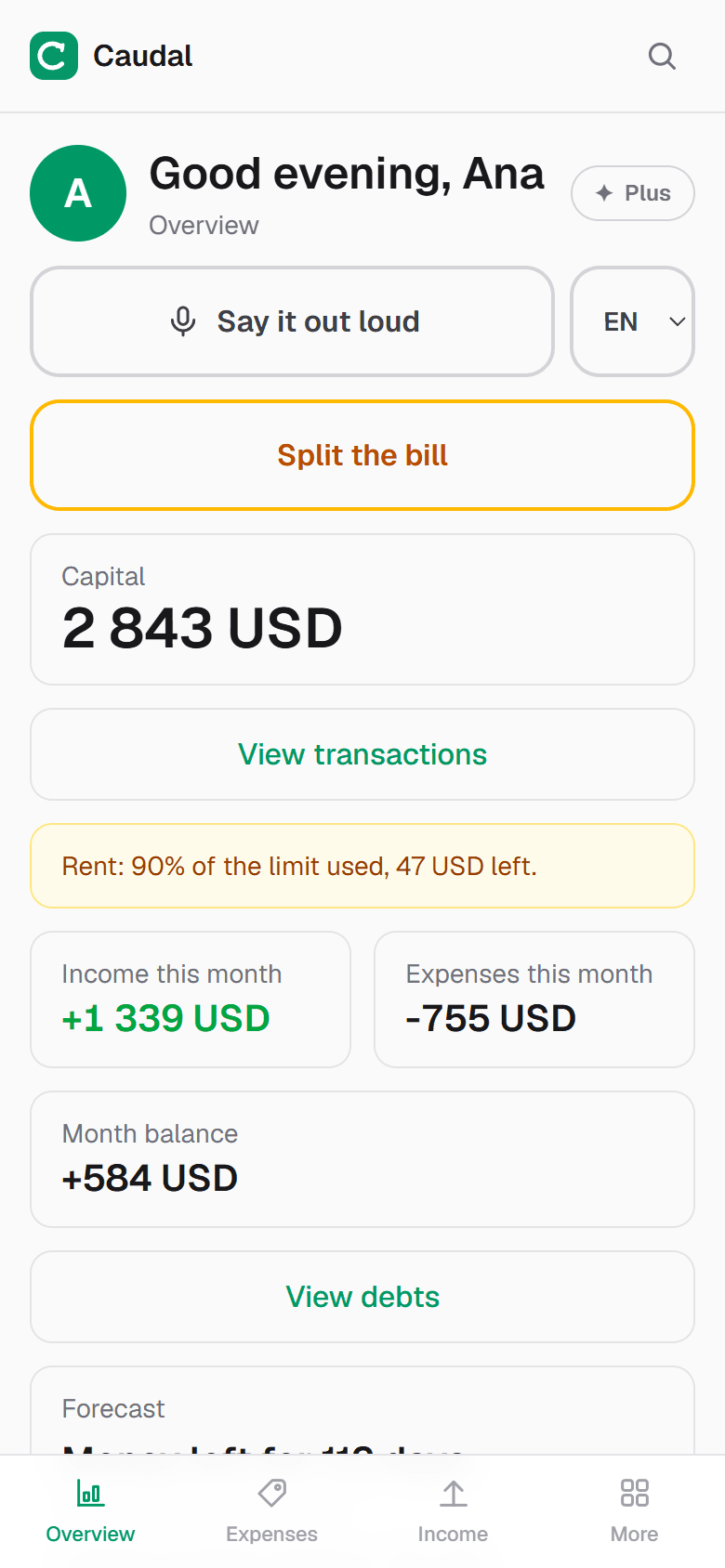
3. What was the difference? Plus or minus. It is the most honest number of the month, and it does not care how the month felt.
4. What surprised you? The category where the figure did not match the expectation. Not "where did most of it go" — usually housing, and that is not news — but where you were most wrong. The surprise is the information.
5. What are you changing? One thing. Exactly one.
Why one change
Because five do not get done. One a month is twelve a year, and that is a great deal: almost nobody changes twelve things about their money in a year.
And because with one change, the end of the next month shows whether it worked. With five, you cannot tell what acted, and the next decision is made blind.
Watch the trend, not the month
One month says almost nothing: it contains a breakdown, a birthday, an insurance premium. Three in a row are what matter.
Compare shares rather than totals — a share survives inflation and a change of income, a total does not. Why, in budgeting when prices keep rising.
A bad month is data
If the month closed in the red, that is not a reason to skip the review — it is precisely the month where a review gives you something. The question is not "why am I like this" but "was that one-off or will it repeat". A broken fridge is one-off. A third consecutive month over on food is not, and it is the next change.
The annual version of the same thing is in the year-end money review.
When to do it
In the first days of the following month, once the old one has closed. Set a repeating reminder: a review that depends on you remembering does not survive the third month.
Common questions
- How often should I review my budget?
- Once a month, fifteen minutes. More often gives noise: weeks differ too much, and what shows up in them is accident rather than trend. Less often and the decision arrives too late to change anything.
- What should I look at first?
- The difference between what came in and what went out, and the category where the figure was furthest from your expectation. The biggest category is usually housing, which is not news; the forecasting error is what is useful.
- What if the month closed in the red?
- Work out whether it was one-off or recurring. A breakdown or an insurance premium is one-off and the cushion covers it. A third consecutive overspend in the same category is not an accident, and it becomes the single change for next month.
Try it on your own money
Caudal is an expense tracker in Spanish, English and Russian. Several currencies, goals, debts, a shared household budget. Recording an expense takes three seconds.
Start free