How to budget when prices rise every month
The problem is not that you spend more. It is that the same purchase has a different number every month, so you no longer know whether you spent more or it simply cost more.
In short
Under inflation a budget is rebuilt monthly rather than yearly, and categories are repriced from last month's actual spending instead of a yearly average. To tell whether you spent more or it cost more, compare the share of income each category took, not the amount. And read each currency's balance on its own: a single converted figure hides exactly what you need to see.
Almost everything written about inflation is about where to put savings. This is about something earlier and duller: how to keep knowing where you stand when the numbers move on their own.
The number that lies
You spent 40 000 on food in March and 62 000 in August. The obvious question is what you did wrong, and the answer is almost always nothing: you ate the same. The 55% increase is the price, not you.
A budget that compares amounts across two different months, in a currency that changed between them, compares nothing. It is fine for paying bills and useless for deciding.
The three numbers that keep their meaning
1 month
How often to reprice
Under high inflation, a yearly budget stops saying anything by month three
% of income
The unit that holds
"Food went from 22% to 29%" says something; "from 40 000 to 62 000" says nothing
Per currency
How to read balances
One converted figure hides which moved: your money or the exchange rate
Reprice the categories, not the whole budget
Rebuilding everything monthly is exactly the kind of chore abandoned in February. What survives is far smaller: look at what the month that ended actually cost, and use it as the limit for the month starting, category by category.
Three or four categories genuinely move — food, transport, utilities — and the rest barely do. So in practice it is four numbers a month, not twenty.
Compare shares, not amounts
This is the change that makes everything else work. Instead of asking how much you spent, ask what portion of that month's income each thing took.
The share survives inflation because wages and prices move in the same direction, though never at the same time. If food went from 22% to 29% of income, that happened, and you know it even though both original numbers changed.
Pay moves too, and later
The uncomfortable part: prices rise every month and pay rises in jumps, two or three times a year. Between one raise and the next, your shares get worse on their own without you doing anything.
That is not a measurement error, that is the measurement working. Seeing that the obligatory share went from 55% to 68% of income in five months is something you can act on; finding out when the month no longer closes is not.
When part of your money is in another currency
It is what many people do in high-inflation countries, and it complicates the arithmetic: add everything up as one converted figure and that figure rises and falls with the exchange rate rather than with you. A month where you saved and the rate moved against you can look identical to a month where you overspent.
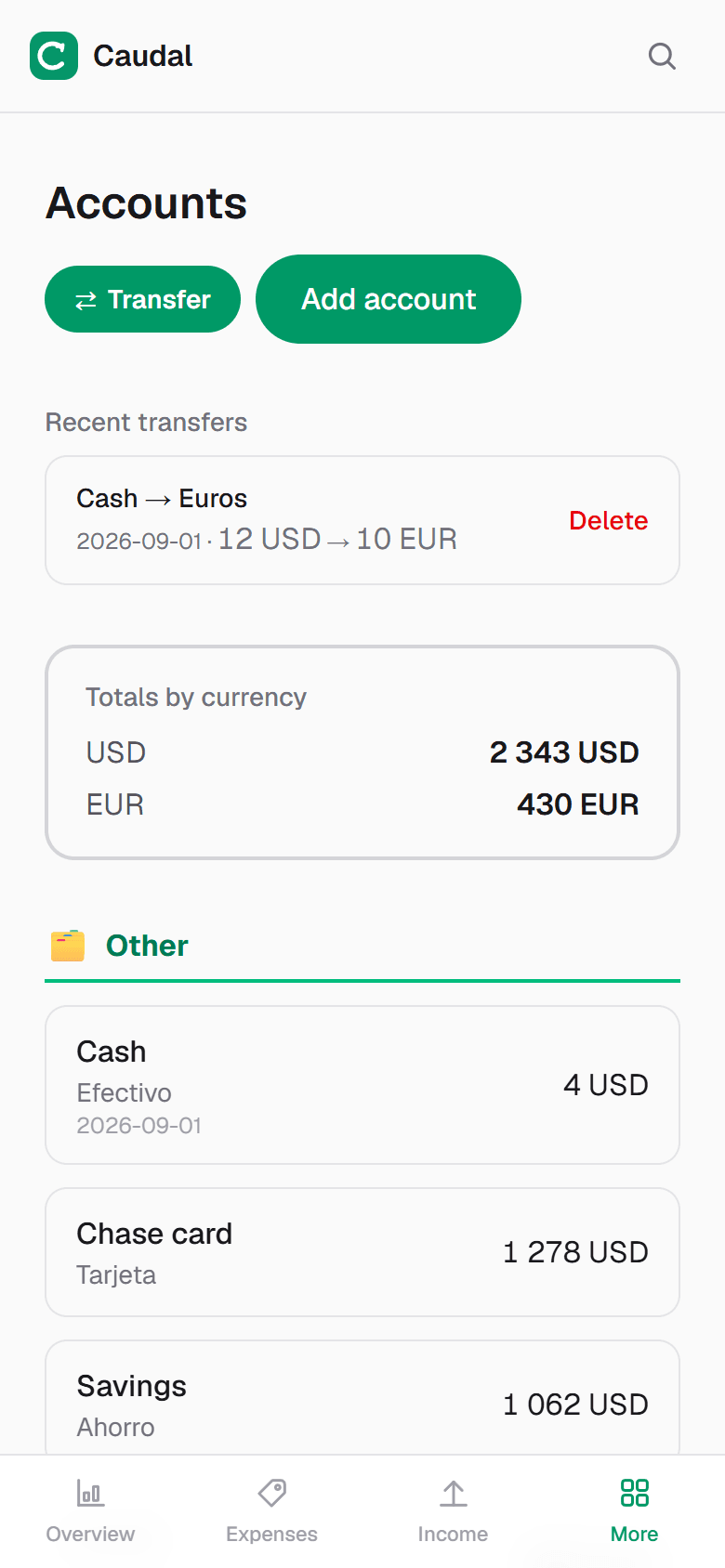
So read each currency on its own, and let the conversion use the rate you actually get rather than the one on the board. The gap between the two is usually 2 to 5%, and across a whole net worth that stops being a detail.
What to review each month
- What share of income each category took, against the month before.
- How much the obligatory part rose: rent, utilities, transport. That is what decides whether next month closes.
- The limits for the month starting: reprice the three or four that moved.
- Each currency's balance separately, not collapsed into one figure.
Fifteen minutes on the first day of the month. It is the only rhythm that holds when the context will not stay still.
Common questions
- Is there any point budgeting if I do not know what things will cost?
- More than ever, but over a different horizon: one month instead of one year. You are not predicting prices, you are measuring what share of your income each thing takes, and that share moves far more slowly than prices do.
- Should I keep my savings in another currency?
- That is a personal decision and depends on which currency you will spend the money in; we do not give investment advice. What holds for any answer: if you hold more than one currency, you need the balances separately, because the converted figure moves with the exchange rate and misleads.
- Which exchange rate should I record a foreign-currency purchase at?
- The one you actually get, not the official or market rate. If you buy 3% away from the market, that 3% applied across everything you own is a large error, and always in the same direction.
- How often should I rebuild the budget?
- Monthly, and only the categories that moved. In practice that is three or four: food, transport and utilities. Redoing all twenty is the reason people stop doing it at all.
Try it on your own money
Caudal is an expense tracker in Spanish, English and Russian. Several currencies, goals, debts, a shared household budget. Recording an expense takes three seconds.
Start free