How to save for retirement on your own
Retirement is the one goal where time works harder than the amount. Every ten years of delay doubles the monthly contribution.
In short
To save for retirement on your own, work out how much you will need each month to live and multiply the yearly figure by twenty-five — a rough target for a pot you can draw down over decades. Save from your first paycheck: at seven percent a year, 100 a month from age 25 grows to about 262 000 by 65; from 45, to about 52 000. Use tax-advantaged retirement accounts where your country offers them.
Retirement is thought about last because it is far away. That is exactly why it is the easiest goal to reach if you start early: time does most of the work.
How much you need
A handy guide is the rule of twenty-five: yearly spending in retirement times twenty-five. If you will need 2 000 a month, that is 24 000 a year and a pot of about 600 000. From a sum like that you can withdraw roughly four percent a year for decades. It is an approximation from US market studies, not a guarantee, but good enough for a plan. A state pension, if you will have one, reduces the amount needed.
Why starting early matters
100 a month at seven percent a year until age 65:
From 25
About 262 000
You put in 48 000
From 35
About 122 000
You put in 36 000
From 45
About 52 000
You put in 24 000
Ten years' difference halves the result for nearly the same contributions. That is compound interest at work. The rate is for the calculation, not a promise: real returns vary and can fall below inflation.
How much to put aside
A simple guide: ten to fifteen percent of income if you start in your twenties or thirties. The later the start, the bigger the share. Starting small beats waiting until «there is something to spare»: the habit matters more, and the amount can rise with every raise.
Where to keep it
- Tax-advantaged retirement accounts. Many countries have them — in the US, a 401(k) or an IRA — where contributions reduce tax. Check these first.
- Employer matching. If your employer matches contributions, not taking the match means turning down part of your pay.
- Long-term investments. Over twenty or thirty years people usually choose broadly diversified funds rather than deposits that barely beat inflation.
Specific products depend on the country; before choosing, understand their fees and tax treatment.
The order
- An emergency fund of three to six months.
- Expensive debt paid off.
- Retirement contributions, regularly, from every paycheck.
If high-interest debt remains, that comes first: save or pay off debt first.
How it looks in the app
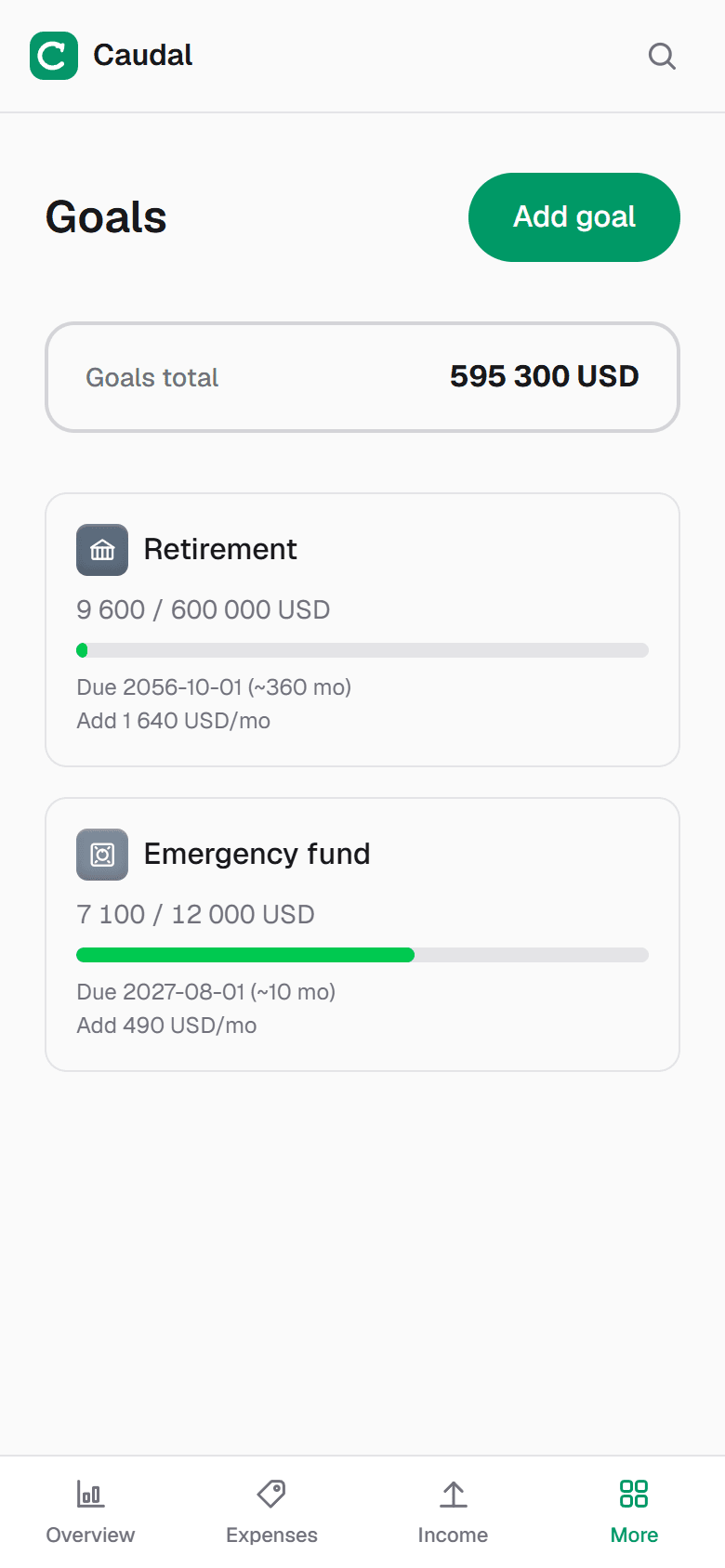
In Caudal retirement is a goal with an amount and a date: the app works out how much to set aside each month and recalculates after every contribution. The goal's money sits in its own account: it counts in your net worth but stays out of the forecast of how long your money lasts, so you cannot spend it by accident. And net worth on the main screen shows, year by year, how what stays with you is growing: how to calculate your net worth.
Common questions
- How much do I need to save for retirement?
- A common guide is yearly spending in retirement times twenty-five. If you will need 2 000 a month to live on, the pot is about 600 000. A state pension reduces that figure.
- How much should I save for retirement each month?
- The usual advice is ten to fifteen percent of income if you start in your twenties or thirties. Start later and the share rises: at seven percent a year, 100 a month from 25 grows to about 262 000 by 65; from 45, to about 52 000.
- Is 40 too late to start saving for retirement?
- No, but contributions will need to be larger and more regular. Twenty-five years to retirement is long enough for compound interest to help noticeably. The worst option is to keep postponing the start.
Try it on your own money
Caudal is an expense tracker in Spanish, English and Russian. Several currencies, goals, debts, a shared household budget. Recording an expense takes three seconds.
Start free