Compound interest: how it works, with examples
Interest earned on interest. After one year you barely notice; after twenty, it is most of the money.
In short
Compound interest is a return calculated not only on what you put in but also on the interest already earned. 10 000 at seven percent a year becomes 19 672 in ten years, 38 697 in twenty and 76 123 in thirty. The rule of 72 gives a quick estimate: divide 72 by the rate to get the years it takes to double. The same mechanism works against you in debt: at forty percent a year, a balance doubles in under two years.
Simple interest is paid only on the original amount: the same every year. Compound interest is paid on the amount plus the interest already added, so each year earns a little more than the one before. In the early years the difference barely shows. After twenty years it is most of the money.
The formula
Final amount = principal × (1 + rate)^years.
If interest is added more often than once a year, divide the rate by the number of periods and multiply the years by it. For 10 000 at seven percent over ten years: 10 000 × 1.07^10 = 19 672.
How 10 000 grows at seven percent
10 years
19 672
Almost double
20 years
38 697
Almost four times
30 years
76 123
Seven and a half times
With simple interest, the same thirty years would give 31 000. The difference — 45 123 — is interest earning interest.
If you add money every month
Most people do not start with a lump sum; they save a little at a time. Example: 100 a month at seven percent a year, compounded monthly.
10 years
17 308
You put in 12 000
20 years
52 093
You put in 24 000
30 years
121 997
You put in 36 000
In the last ten of those thirty years the total grows by almost 70 000, though only 12 000 of it was new money. That is why the main lever is not the size of the contribution but how early you start.
The rule of 72
Divide 72 by the annual rate and you get roughly how many years your money takes to double. At six percent, about twelve years; at nine, about eight. It is an approximation, but good enough to decide with.
Against you: debt
Compound interest does not pick a side. A credit card balance at forty percent a year doubles in under two years by the rule of 72 if left unpaid. That is why expensive debt is almost always worth paying off before saving alongside it: no investment earns what that debt costs. How to decide which comes first: save or pay off debt first.
What eats the result
- Inflation. Seven percent with five percent inflation is about two percent of real growth.
- Fees. One percent a year, over thirty years, takes a noticeable share of the total.
- Withdrawals. Every withdrawal ends the interest that money would have gone on earning.
The rates here are for the calculation, not a promise: real returns depend on where the money sits and change from year to year. Where to keep savings is covered in where to keep your savings.
How it looks in the app
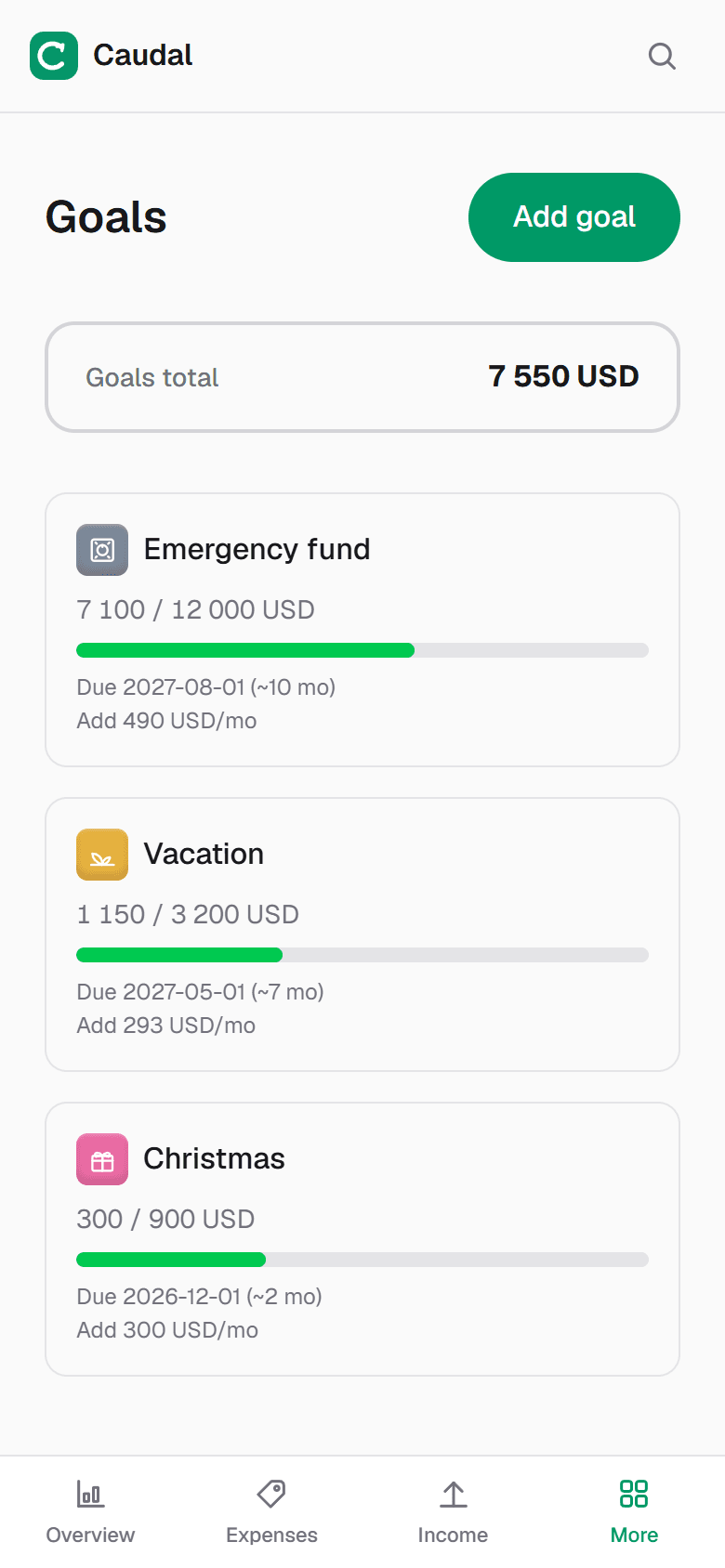
In Caudal a goal is a savings pot with an amount, a date and its own account. Set the amount and date, and the app works out how much to add each month, recalculating after every contribution. If your account or investment paid interest, record it as income on the goal's account: you then see how much of the goal the interest did, rather than you. A worked example with a large sum: how to save a million.
Common questions
- What is the difference between simple and compound interest?
- Simple interest is paid only on the original amount, so you earn the same every year. Compound interest is paid on the amount plus the interest already added, so what you earn grows each year. Over thirty years at seven percent, 10 000 becomes 31 000 with simple interest and 76 123 with compound.
- How can I quickly work out when my money will double?
- Use the rule of 72: divide 72 by the annual rate in percent. At six percent it doubles in about twelve years; at eight, in about nine. It is an approximation, but enough for a decision.
- Where does compound interest apply?
- Anywhere interest stays in and keeps earning: savings accounts, deposits that add interest to the balance, reinvested investment returns. And in debt: unpaid credit card interest starts earning interest for the bank too.
Try it on your own money
Caudal is an expense tracker in Spanish, English and Russian. Several currencies, goals, debts, a shared household budget. Recording an expense takes three seconds.
Start free