How to calculate your net worth, the one number that does not lie
Your salary says how much came in. Your net worth says how much you kept, which is not the same thing and almost nobody measures it.
In short
Net worth is everything you have minus everything you owe, counted on the same day. In go cash, the balance of every account, money owed to you and what your possessions are worth today; out come cards, loans and unpaid instalments. Look once a month, on the same date, and only the direction matters: three months rising means the system works, even if the month felt tight.
It is the figure people who manage money seriously use, and the one almost nobody calculates for themselves. You do not need much for it to be useful: it is useful precisely when there is little, because it is the only thing that separates a month where you earned from a month where money merely arrived.
The formula, in full
Everything you have, minus everything you owe. There is no more to it.
Add
What you have
Cash, every account balance, money owed to you, possessions at today's value
Subtract
What you owe
Cards, loans, unpaid instalments, money owed to people
Once a month
How often to look
The same date each month, so months are comparable
What counts and what does not
This is where most people get it wrong, and always in the same direction: upwards.
- Cash counts. It is the part no app sees on its own and the first thing forgotten.
- Money owed to you counts, if you genuinely expect it back. If you do not, it is not an asset: it is a memory.
- Interest-free instalments count in full. The most expensive omission. Twelve remaining payments are a whole debt today, not a monthly inconvenience.
- The car and the things, at what they are worth now, not what you paid. A five-year-old car is not worth what it cost, and counting it that way inflates the number exactly when you wanted the truth.
- Next month's pay does not count. You do not have it. Counting it is the fastest way to make the number useless.
Why a good month can hide a net worth that fell
This is the situation the number exists to catch. More came in than ever, the month felt prosperous, and yet thirty days later you have less: because two instalment purchases appeared and the card grew faster than the account did.
Nothing in a monthly income-and-expenses summary shows that. Net worth does, because it is the only figure that looks at both sides at once.
More than one currency: look at both
If your money sits in several currencies, net worth collapsed into one converted figure moves with the exchange rate rather than with you. A month where you saved can look flat.
The answer is not to choose but to read both: the converted total for the overall trend, and each currency's balance separately for what you actually did. It is worked through in budgeting when prices keep rising.
What to do with the number
Nothing, the first month. Just write it down.
By the third it starts to mean something, because there is a direction. And the direction is all that is needed: three months rising means the system works, even if the last one felt tight. Three months falling on steady income means there is a leak, and the question becomes where does my money go.
Common questions
- Does the home I live in count?
- It can, at what it would fetch today, with the mortgage subtracted on the other side. Many people keep two figures, one with the home and one without, because the second is the one that answers whether the month closes.
- What if my net worth is negative?
- It is more common than it looks, especially with student loans or a financed car, and it does not mean you are doing anything wrong. Only the direction matters: a negative that moves towards zero every month is a plan that works.
- How often should I calculate it?
- Once a month, on the same date. More often adds the noise of exchange rates and pay dates without adding information, and less often takes too long to show a trend.
Try it on your own money
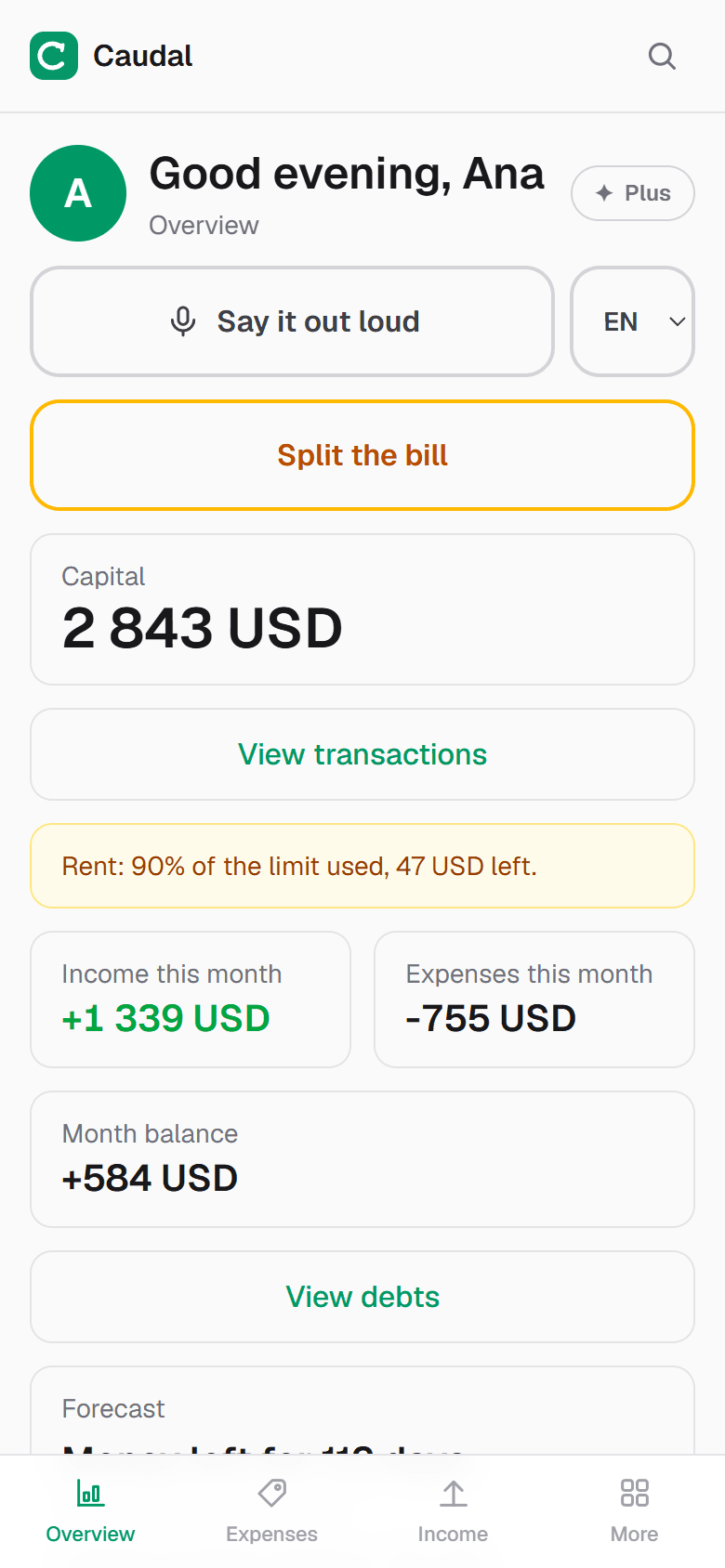
Caudal is an expense tracker in Spanish, English and Russian. Several currencies, goals, debts, a shared household budget. Recording an expense takes three seconds.
Start free