Where does my money go: how to find out in 30 days
Almost nobody who asks this is overspending on one big thing. They are spending on many things they have never seen side by side.
In short
There is one method for finding out where your money goes: record everything for 30 days without changing anything you do. A bank statement is not enough because it cannot see cash and groups things badly, and memory is not enough because it keeps the rent and erases the rest. At the end of the month three numbers answer the question: what actually came in, what went on obligations, and what went on everything else.
It is the most common question about money and also the easiest to answer, on one condition: the answer takes a month to arrive. There is no shortcut, and every shortcut on offer fails for the same reason — they try to reconstruct the past instead of measuring the present.
Why the bank statement does not answer it
It is the first place everyone looks, and it is half an answer for three reasons.
- It cannot see cash. A 3 000 withdrawal shows up as "withdrawal, 3 000". Where it went afterwards is recorded nowhere, and in many countries that is a third of your spending.
- It groups things badly. The supermarket where you also buy electronics stays "supermarket". Automatic categorisation gets it right roughly seven times out of ten, and the three it misses are the interesting ones.
- It cannot see your other accounts. The card at another bank, the digital wallet, what you pay in cash, what somebody transfers you. A statement is one account, not your money.
Measure first, decide later
The temptation is to start cutting on day one. It does not work, for a simple reason: if you change your behaviour while measuring, you measure a month that is not your month.
Thirty days recording everything, without judging and without correcting anything. It is awkward for three days and then it becomes automatic, and at the end you have the only figure worth having: your real month.
30 days
How long to measure
A full month, because many costs happen only once a month
10-12
How many categories
Fewer and the causes are invisible; more and it never gets filled in
3 numbers
The answer
What came in, what was obligatory, and everything else
How many categories, honestly
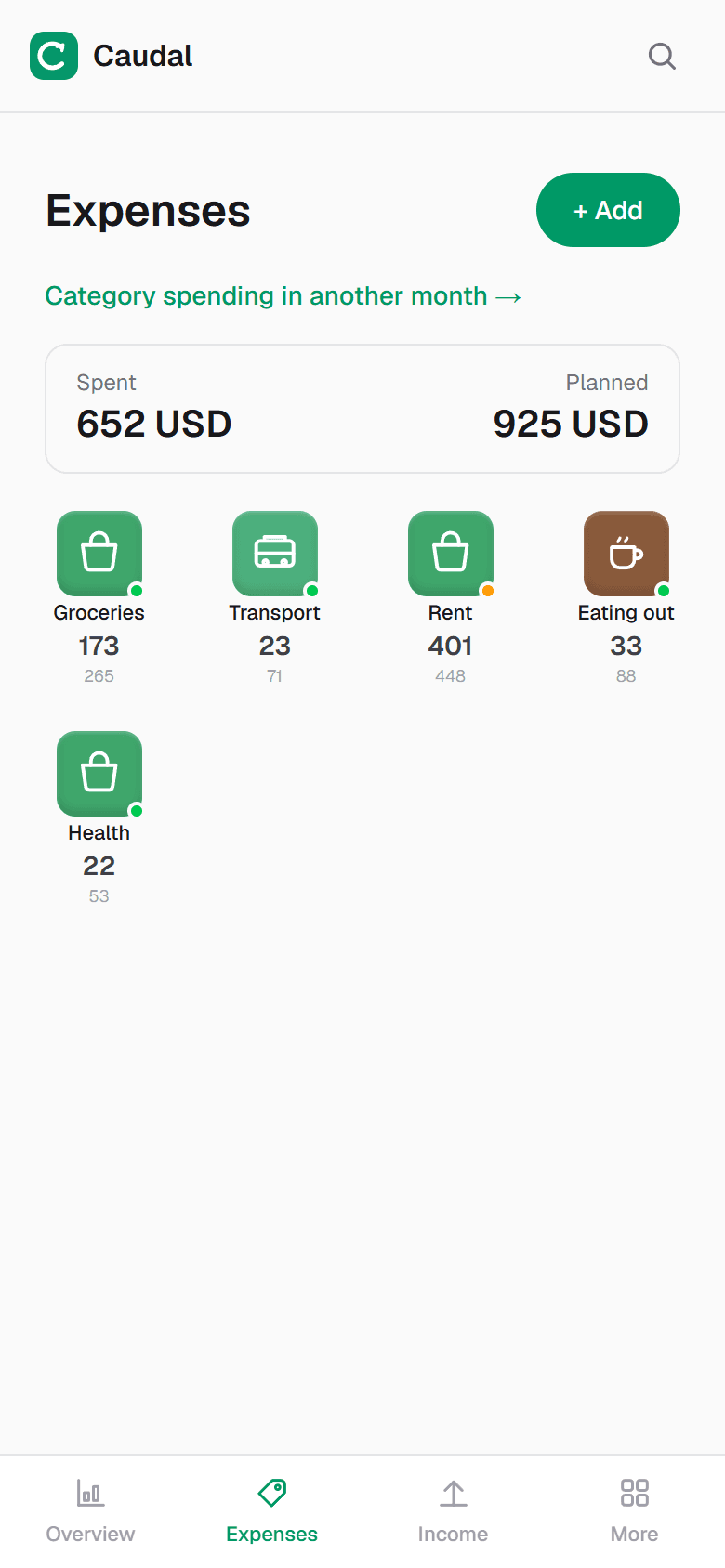
Ten or twelve. With five, "other" takes half of it and you have learned nothing. With thirty, choosing which one each purchase belongs to takes long enough that you stop recording within ten days.
A list that works almost always: housing, utilities, groceries, eating out, transport, health, education, clothes, subscriptions, leisure, debts, and an "other" that should stay small.
The three numbers
When the month ends you do not need to analyse twenty lines. You need this:
- What actually came in. Not gross pay or the figure in the contract: what reached the account, plus any other income.
- What went on obligations. Housing, utilities, transport to work, debts, insurance. What gets paid no matter what.
- What went on everything else. The subtraction. This is the number almost nobody knows and the only one you can decide anything about.
If the third is smaller than you expected, you already know where the money goes: it goes into the second, and the problem is structural rather than a matter of willpower. If the third is large and there is still nothing left, the answer is in the detail, and that is when looking category by category is worth it.
What almost always turns up
After thirty days the list of surprises is strikingly similar across very different people: weekday food away from home, delivery apps, subscriptions still charging, bank fees and short taxi rides. They are counted out with numbers in small daily spending.
What matters is that after measuring it is no longer a suspicion. It is a figure, and a figure can be decided on.
Common questions
- Can I work it out from last month's transactions instead of recording for thirty days?
- It gives you part of it, and the missing part is the one you care about: cash, your other accounts, and everything automatic categorisation filed in the wrong place. It is a way to start, not a way to answer.
- How long does recording expenses take each day?
- About a minute a day if you record at the moment of paying, and considerably longer if you leave it for Sunday, because then you have to remember. The difference between the two is not the time, it is how many purchases go missing.
- What if I forget to record for a few days?
- Count the cash you have left and record the difference as one expense in the most likely category. Losing the detail is far better than losing the total, which is what decides whether the month closes.
- After the 30 days, do I have to keep recording everything?
- The first month is the one that answers the question. Most people carry on, because by then it takes a minute and because a measured month with nothing to compare it against loses half its value.
Try it on your own money
Caudal is an expense tracker in Spanish, English and Russian. Several currencies, goals, debts, a shared household budget. Recording an expense takes three seconds.
Start free