How to run a household budget: income and expenses
A household budget is not a spreadsheet or an app. It is an agreement about where the shared money goes, written down so both of you can see it.
In short
Running a household budget means knowing all the household's income, splitting expenses into essential and optional, and allocating money in the same order every time: savings first, then yearly costs divided by twelve, then fixed payments, and only the rest for day-to-day spending. Record expenses when you pay, and review the month once a month, together.
Most households do not "not know how" to budget. They keep the budget in one person's head, and that person gets tired. A household budget begins when both people can see the picture and it no longer depends on what anyone remembers.
Household income
Everything that actually reaches the household's accounts:
- everyone's salaries;
- side jobs and one-off work;
- benefits, pensions, child allowances;
- rental income, interest.
Count what reached the account, not the figure in the contract. If income varies, plan with the lowest of the last three months: a budget built on your best month will mislead you all year.
Household expenses
Essential
Paid regardless
Housing, utilities, food, transport, debt, children
Yearly ÷ 12
Arrive rarely
Insurance, tax, back-to-school
Optional
Decided each time
Eating out, entertainment, extra purchases
Essential expenses: what gets spent in any month — housing, utilities, food, transport, phone, loan payments, the children's costs.
Yearly expenses: insurance, taxes, back-to-school, the car service. They arrive once a year but have to be paid for every month: divide the yearly amount by twelve and set it aside. Otherwise they arrive as a crisis.
Optional expenses: everything that depends on a decision — eating out, entertainment, clothes beyond what is needed. This is where the slack is, if you need it.
The order money is allocated in
This matters more than the exact amounts. On the day the money arrives:
- Savings first. Otherwise there will be none: spending grows to whatever is visible.
- Then yearly costs, divided by twelve.
- Then fixed payments — rent, loans, utilities.
- The rest for day-to-day spending, conveniently divided by the days until the next payday.
Step by step, in what to do on payday.
Who keeps the accounts
Two options work. Either one person keeps the records but both see the result, or both record their own spending, at the moment they pay. The third, most common option does not work: one person runs everything, the other sees nothing and finds out about problems once they have already happened.
How to split shared costs when incomes differ, and what to keep personal, is in budgeting as a couple.
Once a month, twenty minutes together
What came in, what went out, what surprised you, what you change next month. One change, not five. A conversation with a set time stops happening at the worst moment with raised voices. How to run that review is in a monthly money review.
Where to start tomorrow
Not with a plan but with measuring. For one month, record every expense without changing anything, and only then decide what to cut. A budget made before measuring is nearly always invented. If you want a spreadsheet, here are the columns it needs.
Common questions
- How do you run a household budget?
- Know all the household's income, split expenses into essential and optional, allocate money in the same order every time — savings, yearly costs divided by twelve, fixed payments, the rest for day-to-day — and review the month together once a month.
- What expenses go in a household budget?
- Essential ones — housing, utilities, food, transport, phone, debt, children; yearly ones — insurance, taxes, back-to-school, divided by twelve; and optional ones — eating out, entertainment, extra purchases.
- Who should manage the family budget?
- Either one person, as long as both see the result, or both, each recording their own spending when they pay. What does not work is one person running everything while the other sees nothing.
Try it on your own money
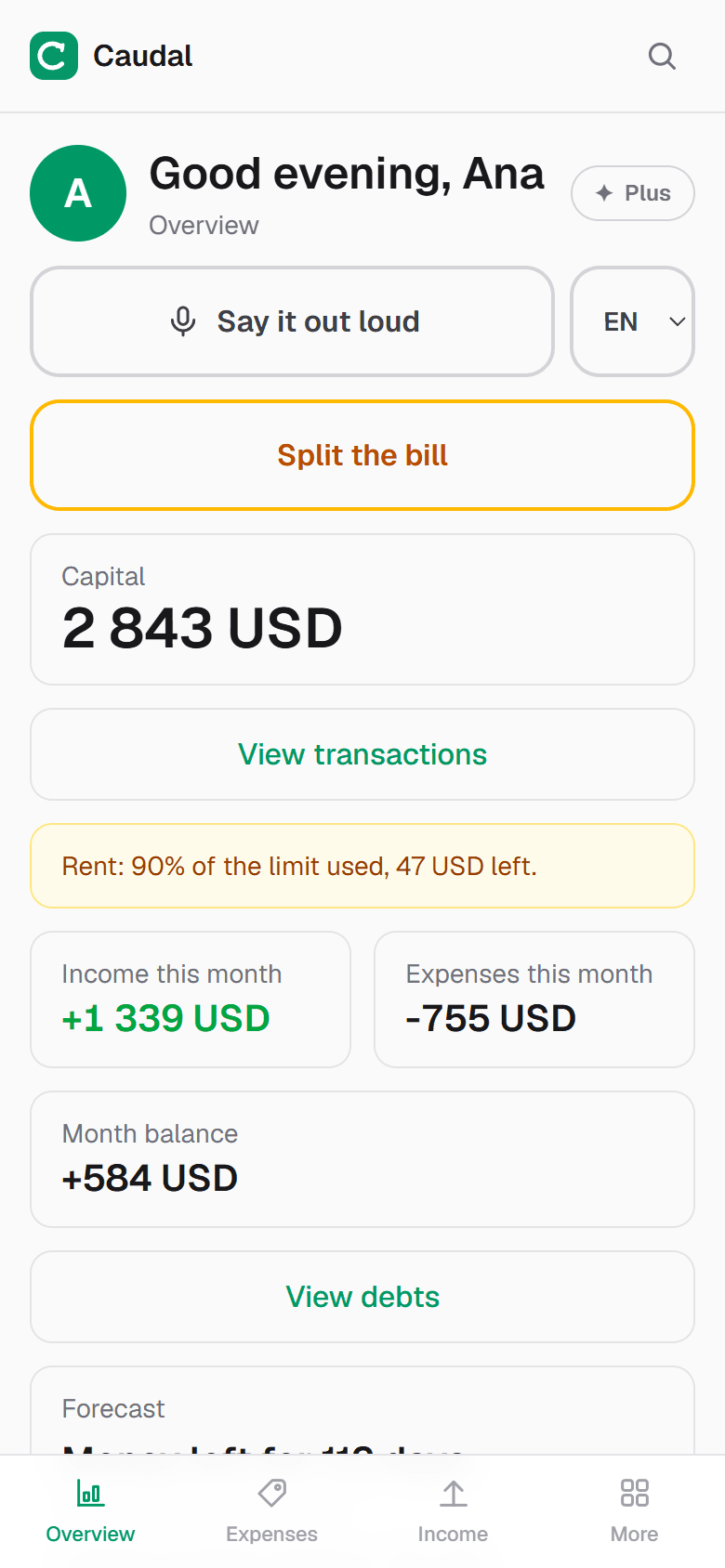
Caudal is an expense tracker in Spanish, English and Russian. Several currencies, goals, debts, a shared household budget. Recording an expense takes three seconds.
Start free