What to do on payday: four steps
The month is not decided on the thirtieth. It is decided on the day the money arrives.
In short
Payday needs four steps in this order: move the savings out, move out the yearly costs divided by twelve, settle the obligations, and divide what is left by the days. The order is the whole method: what gets saved after the spending never gets saved, because spending expands to fill exactly what is available.
A familiar shape: the first week after payday is rich and the last one is poor. It is not irresponsibility — it is that the whole month's money is visible in the account, and the mind reads it as today's.
Five minutes, four steps
1. Savings
First, not last
The remainder does not remain — an observation, not a moral
2. Yearly ÷ 12
Insurance, tax, tuition
Otherwise it arrives as a catastrophe
3. Obligations
Rent, debt, subscriptions
Everything that has to be paid anyway
4. Rest ÷ days
What today allows
The one number worth remembering
First: savings, and genuinely first
Not because it is an elegant principle but because otherwise there will not be any. Spending expands to fill what is available without anybody deciding it should — true on a small salary and on a large one.
How much is in what percentage of income to save. Briefly: as much as will survive twelve months in a row, which for most people is five to ten percent, not twenty.
Best of all if the transfer goes automatically on the day the money lands. A decision that has to be taken every month will one day be taken the other way.
Second: the yearly costs, divided by twelve
Insurance, tax, tuition, the annual service. These are not rare events — they are ordinary costs that arrive rarely.
A twelfth set aside turns them from catastrophe into payment. It is the line most often missing from the accounts of people who "just about manage, but something always happens".
Third: obligations
Rent, utilities, debt, subscriptions. Pay them or set them aside, but separate them from free money on the same day.
While the compulsory payments sit in the same pile as everything else, every figure on the screen is overstated by exactly their size — and decisions get made from it.
Fourth: what is left, divided by days
Divide the remainder by the number of days until the next payment. That is your figure for today, and it is the only number worth carrying around.
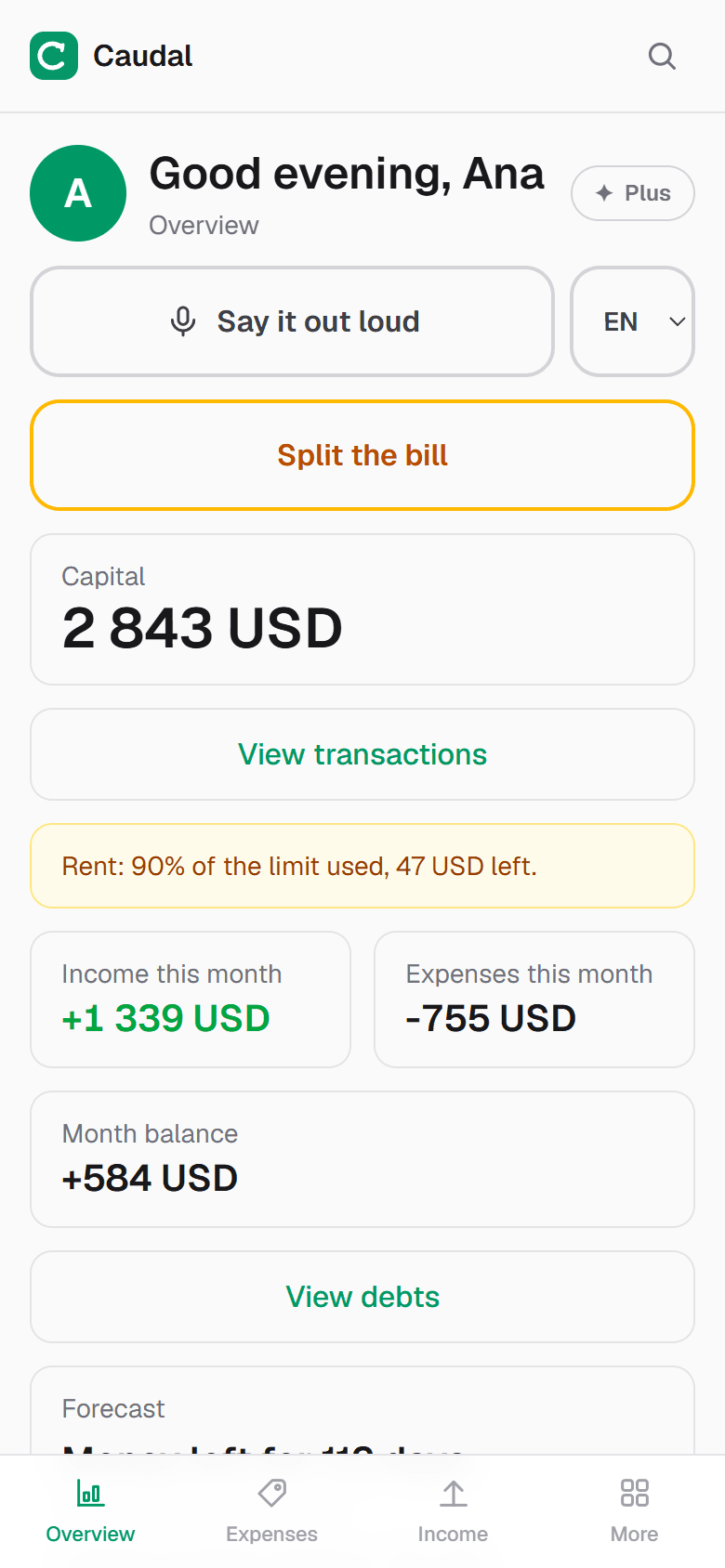
It handles mistakes by itself: an expensive Saturday shrinks tomorrow by a few percent rather than breaking the month. The full arithmetic is in how much can I spend today.
If the pay is irregular
Then the day it arrives is not the day it gets divided. The money goes into a buffer, and once a month you pay yourself a fixed salary out of it and run that through the four steps. The detail is in how much to pay yourself.
Why this works
Because it moves every decision of the month into one calm moment, when you are not hungry, not tired and not standing at a till. What is left afterwards is one number — and one number survives thirty days far better than a set of intentions.
Common questions
- What should I do first on payday?
- Move the savings out, before any spending. The order here is the method: what gets saved out of the remainder does not get saved, because spending expands to fill exactly what is available.
- How do I stop spending it all in the first week?
- Divide the free remainder by the number of days until the next payment and carry only that number. The whole month's money visible in the account reads as today's money — hence the rich first week and the empty last one.
- What if I am paid twice a month?
- The same four steps at each payment, at half the amounts. Attach the large obligations to whichever payment falls closer to the due date, so the money does not sit around being spent.
Try it on your own money
Caudal is an expense tracker in Spanish, English and Russian. Several currencies, goals, debts, a shared household budget. Recording an expense takes three seconds.
Start free