Budget categories: a ready-to-use list
A good category list is not the most detailed one but the one you will still be filling in six months from now.
In short
Ten or twelve budget categories are enough for a household: housing and utilities, groceries, transport, phone and subscriptions, health, clothing, children, eating out, entertainment, gifts, debt payments and miscellaneous. Subcategories can live inside them, but the top level should fit on one screen. Saving is not an expense but a transfer to a goal, so keep it separate.
Spending categories are there for one thing: so that at the end of the month the report tells you where the money went without combing through it by hand. Too few, and you cannot see the causes. Too many, and recording turns into picking from a list; within a month it stops.
The basic list
Housing
Rent or mortgage, utilities, repairs
Usually the largest
Groceries
Supermarket, market
Separate from eating out
Transport
Fares, rides, fuel, car
Everything about getting around
Phone and subscriptions
Phone, internet, services
Recurring charges
Health
Doctors, medicines, tests
Beyond insurance
Clothing
For adults
Children's goes under Children
Children
School, activities, clothes, toys
Shows what children cost
Eating out
Restaurants, coffee, takeaway
The most flexible one
Entertainment
Cinema, hobbies, weekend trips
No guilt, but a limit
Gifts
Birthdays, holidays
Predictable, yet forgotten
Debt payments
Loan and instalment payments
If not under Housing
Miscellaneous
What does not fit
Over five percent means split it
Rules that keep the list alive
- The top level fits on one screen. Add subcategories inside, but recording should take two taps.
- Categorise by purpose, not by shop. Cat food from the supermarket is Pets, not Groceries.
- Miscellaneous is a warning light. If more than five percent of spending lands there, it is hiding a category of its own.
- Saving is not spending. A transfer to savings lowers the balance, but it is still your money; otherwise the report says you «spent» more than you did.
Essential and non-essential
Mark each category as essential (housing, groceries, health, debt) or non-essential (eating out, entertainment, some clothing). Then you see what part of the budget is flexible and where to take from when a month goes wrong. More in fixed and variable expenses.
The first month
Do not try to design the perfect list in advance. For a month, record everything in the basic categories, then see where the totals surprised you and where a subcategory is needed. How to run the whole budget: how to run a household budget.
How it looks in the app
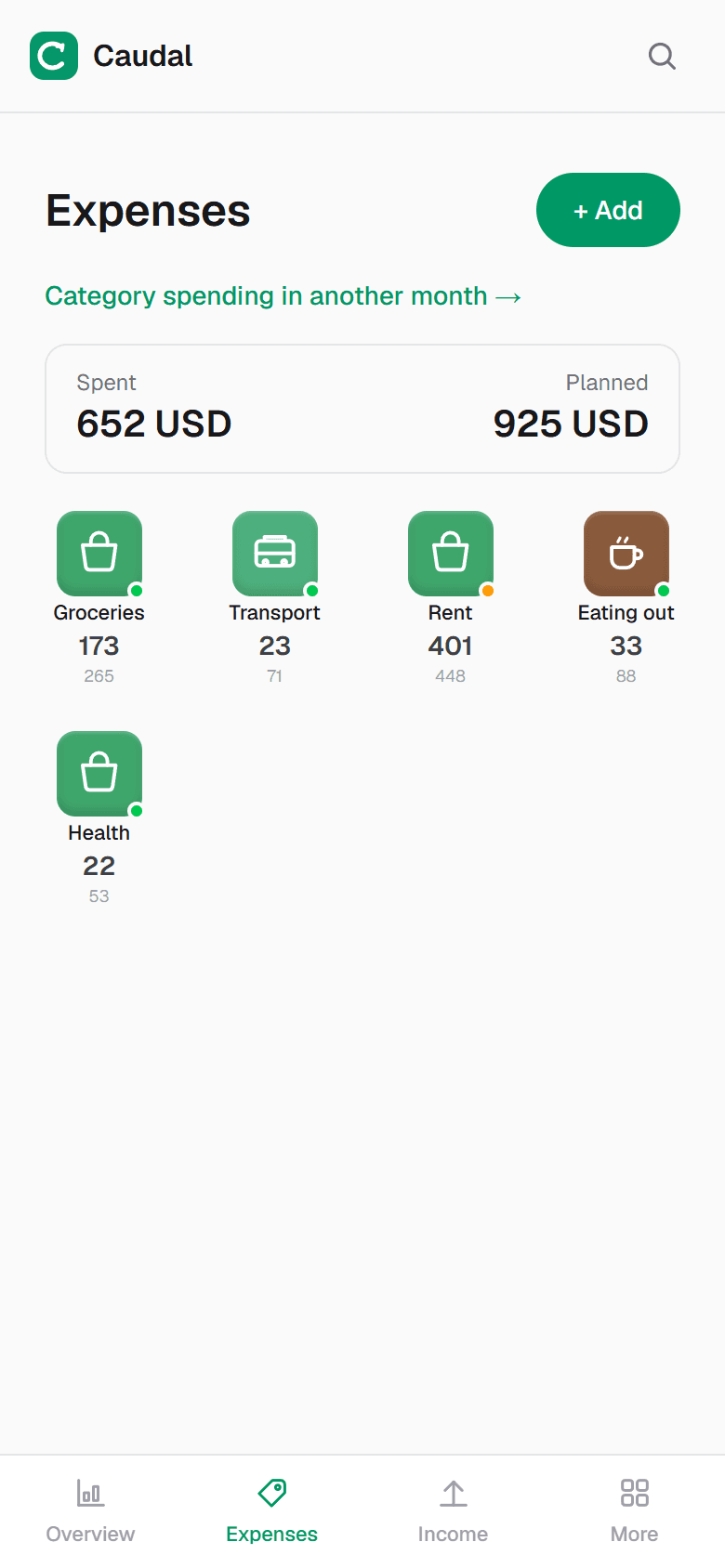
In Caudal you start with a set of categories you can rename, delete or extend with subcategories, each with its own icon and colour. Categories can be marked essential or non-essential, and each can have a monthly limit — the app warns you as it runs out. The Expenses screen shows the month by category, and the reports show how it changed.
Common questions
- How many categories should a budget have?
- Ten or twelve at the top level. Fewer, and the report cannot explain where the money went; more, and recording takes too long and gets dropped. Detail can live in subcategories.
- Should savings be recorded as an expense?
- No. Saving is moving your own money to a goal or another account. Recorded as an expense, it inflates spending in the report and understates what you own.
- What if a lot of spending ends up in Miscellaneous?
- Look at what repeats there and give it its own category. If Miscellaneous is over five percent of spending, it usually hides something worth seeing separately: pets, repairs, gifts.
Try it on your own money
Caudal is an expense tracker in Spanish, English and Russian. Several currencies, goals, debts, a shared household budget. Recording an expense takes three seconds.
Start free