What is APR, and how to use it to compare loans
The interest rate tells you what the lender charges for the money. The APR tells you closer to what the loan really costs.
In short
APR, the annual percentage rate, is the yearly cost of a loan expressed as one percentage: the interest rate plus certain fees, such as origination fees, spread over the term. Use it to compare offers of the same amount and length: the lower APR is the cheaper loan, even if its advertised rate is higher. On credit cards the APR is simply the interest rate, and you only pay it on balances you carry past the due date.
One lender advertises 7.9%, another 8.4%. The first charges a 5% origination fee, and over three years it ends up costing more. That is the gap the APR is there to close.
What APR includes
Included
Interest rate
What the lender charges for the money
Included
Origination and some lender fees
Spread over the life of the loan
Not always
Late fees and penalties
Only if you trigger them
Credit cards
APR equals the interest rate
Annual fees are separate
Lenders in the United States must disclose the APR under the Truth in Lending Act, calculated the same way, which is what makes it useful: you can line offers up side by side.
How to read it
Compare APRs only between loans of the same amount and the same term. A longer loan can show a lower monthly payment and still cost more in total. And the APR does not tell you whether you can afford the payment; your budget does.
On a credit card, the APR only matters if you carry a balance. Pay the full statement balance by the due date and you pay no interest at all. Pay only the minimum, and the APR is exactly what you pay: credit card minimum payment.
Three common mistakes
- Comparing interest rates instead of APRs. The rate leaves out the fees.
- Comparing monthly payments. A longer term lowers the payment and raises the total.
- Treating 0% promotions as free. They are, until a payment is late or the promotion ends: interest-free instalments.
Before you sign
Ask for the total you will repay over the life of the loan, in dollars. That number minus the amount you borrow is the real cost. If it still makes sense, go ahead.
How it looks in the app
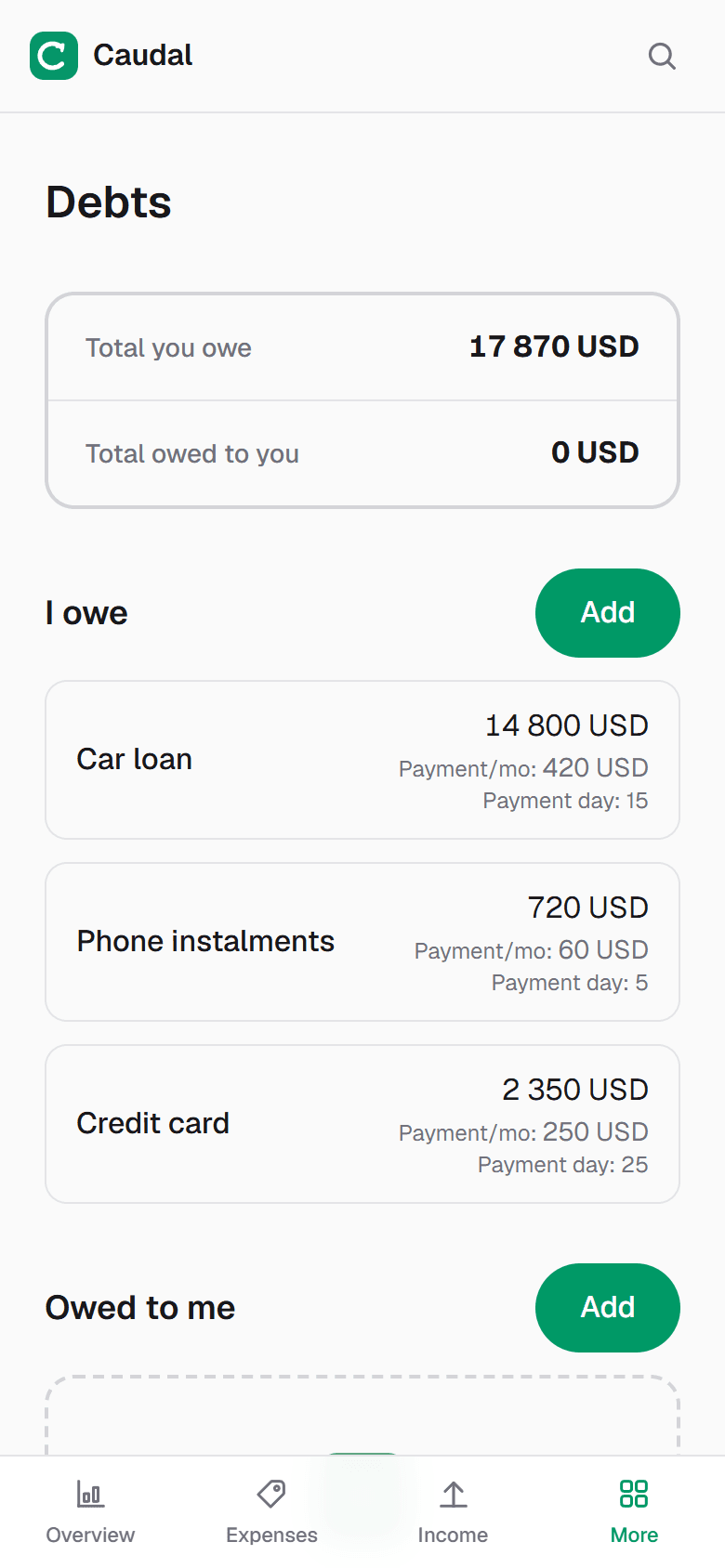
In Caudal every debt has its balance, its monthly payment and its due date. The app adds up what goes to debt each month and shows how much of your income it takes, which is the one thing an APR cannot tell you: whether this loan fits your month.
Common questions
- Is APR the same as the interest rate?
- On credit cards, yes. On loans, no: the APR adds certain fees, such as origination fees, to the interest rate, so it is usually higher and a better measure of the real cost.
- What is a good APR?
- It depends on the type of credit. Mortgages and car loans for good credit sit in single digits, personal loans range widely, and credit cards often run above 20%. Compare against other offers of the same type, amount and term.
- Does APR matter if I pay my card in full?
- No. If you pay the full statement balance by the due date, you pay no interest on purchases, whatever the APR.
Try it on your own money
Caudal is an expense tracker in Spanish, English and Russian. Several currencies, goals, debts, a shared household budget. Recording an expense takes three seconds.
Start free