Weekly budget: how to work it out and make it last
A month is too long to feel your money. A week is just the right size.
In short
A weekly budget comes from the monthly one: subtract fixed costs and saving from your income, then divide what is left by the number of weeks in a month — 4.3 on average. For example, 1 380 a month to live on is about 320 a week. A weekly budget covers only flexible spending: groceries, transport, eating out, small things. If you overspend one week, take it out of the next one rather than forgiving it.
A weekly budget does not replace the monthly one — it makes it visible. The thirtieth is too late to discover that the money ran out on the twentieth. Sunday is not.
How to work out the weekly figure
1. Monthly income
What will definitely arrive
After tax
2. Minus fixed costs
Rent, loans, phone
Paid once a month
3. Minus saving
On payday
At least 5–10%
4. What is left ÷ 4.3
Weeks in a month
That is your weekly budget
Dividing by four is a mistake that eats a whole week every quarter: a month has 4.3 weeks on average. Example: income 3 200, fixed costs 1 500, saving 320. That leaves 1 380, about 320 a week.
What goes in a weekly budget
Only what you spend little and often: groceries, transport and rides, lunches and eating out, household bits, small treats. Rent, loan payments and subscriptions do not — they are already subtracted. Big purchases — clothes, electronics, gifts — do not either: save for those separately, or one purchase wipes out the week. How much to save each month for a big purchase.
A biweekly budget
If you are paid every two weeks, count in pay periods instead: from one paycheck to the next. Same principle — from each paycheck subtract the bills it pays, and divide the rest by the days until the next one. How to spread bills across two paychecks: how to split your paycheck.
If the week went over
Take the overspend out of next week, and the month still balances. If you go over every single week, the figure is not realistic: find where the extra goes — usually groceries and delivery. How much to spend on groceries. If you finish a week with money left, do not save it "to spend later" — move it to savings, and the saving becomes visible.
Shorter still: a daily figure
The weekly figure divided by seven is what you can spend per day. Some people find that easier: one number you see every morning. How much can I spend today.
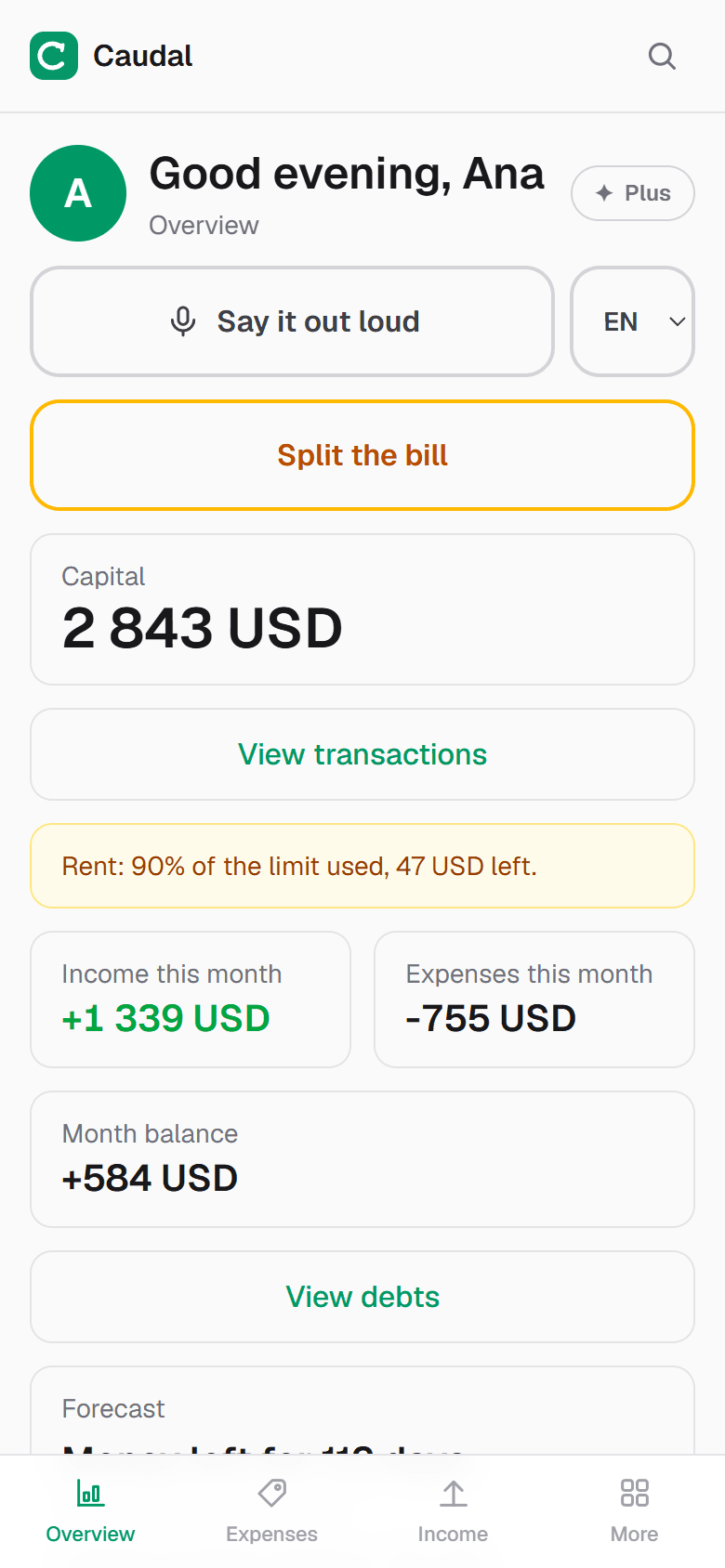
How it looks in the app
In Caudal the home screen shows how much you can spend today: income minus fixed costs and saving, over the days that are left. It is the same weekly budget, recalculated by the day — spend less and tomorrow's figure goes up, spend more and it goes down. Category limits are monthly, and the transaction list can be filtered by any period, including a week, to see where the money went.
Common questions
- How do I calculate a weekly budget?
- Subtract fixed costs and saving from your monthly income and divide what is left by 4.3, the average number of weeks in a month. For example, 1 380 a month to live on is about 320 a week.
- What should a weekly budget include?
- Only frequent, flexible spending: groceries, transport, eating out, household bits and small treats. Rent, loans and subscriptions are already taken out of the monthly income, and big purchases are better saved for separately.
- What if I go over my weekly budget?
- Take the overspend out of next week so the month still balances. If you go over every week, the figure is unrealistic — find the category where the extra goes and redo the numbers.
Try it on your own money
Caudal is an expense tracker in Spanish, English and Russian. Several currencies, goals, debts, a shared household budget. Recording an expense takes three seconds.
Start free