Lost your job? What to do with your money first
In the first week without a job you want to start applying. But first spend one evening on money — it decides how much time the search has.
In short
If you have lost your job, on the first evening work out your runway: all the money you can reach, divided by your essential monthly costs, is the number of months it lasts. Cut the budget to essentials, check your final pay, any severance and whether you qualify for unemployment benefits, and warn lenders before the first missed payment. Do not cover costs with a credit card: the debt grows faster than the search moves.
Losing a job is also a question of time: how many months you can look for the next one without taking the first offer out of desperation. The answer is a single calculation.
Step 1. How many months you have
Cushion
Savings, last paycheck, final pay
Everything reachable without debt
Essential costs
Housing, food, phone, transport, debt
No eating out or subscriptions
Cushion ÷ costs
Months of runway
Your time to search
If it comes to less than three months, look for temporary income alongside, not only the ideal job.
Step 2. Cut to essentials
- Cancel subscriptions and recurring payments you do not need.
- Move phone and internet to cheaper plans.
- Groceries from a list, with a weekly limit.
- Big purchases: postpone, even if «already decided».
This is a temporary mode, not a new life. Its job is to stretch the cushion.
Step 3. What you are owed
Check what is due when you leave: final pay, unused holiday, severance if you were laid off. Most countries offer unemployment benefits or insurance, with their own rules and deadlines — in the US, through your state, and applying early matters.
Step 4. Debts
If you have loans, tell the lenders before the first missed payment. Many offer hardship plans or deferrals when income drops. What to do if the payments do not fit: can't pay your loans.
What not to do
- Do not live on a credit card «until the first paycheck»: the search may take longer, and interest runs every day.
- Do not spend the cushion on big purchases «while I have the time».
- Do not hide it from the family: a shared budget is cut faster when everyone knows why.
When the job comes
The first paychecks go to recovery: rebuild the emergency fund and clear any debt that built up during the search. How big the fund should be so next time is calmer: emergency fund.
How it looks in the app
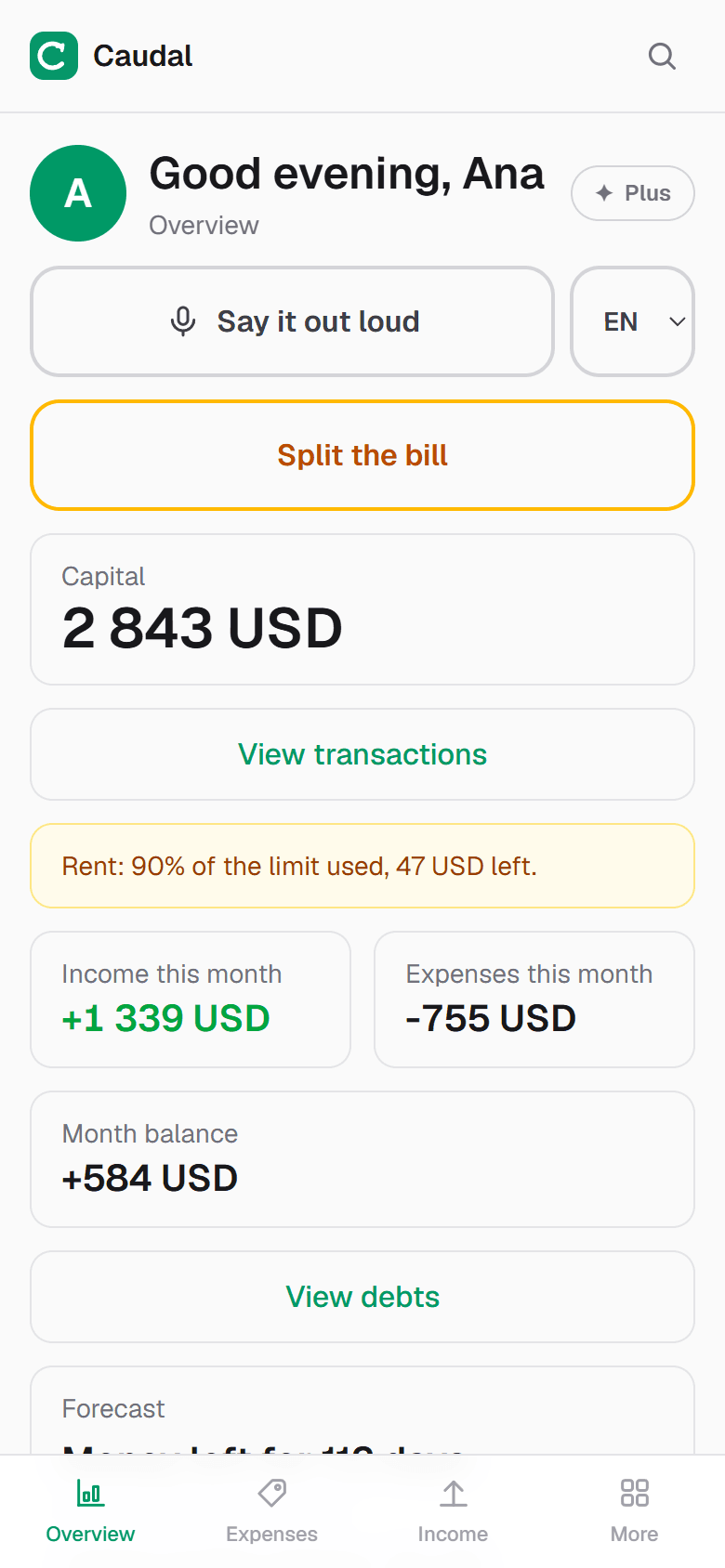
In Caudal the main screen shows the forecast: how many days the remaining money lasts, with fixed payments and debts already counted. While you search for work, that is the key number, and it updates after every expense. Delete the subscriptions you cancelled from «Recurring» and the forecast becomes more accurate; category limits help you hold the reduced budget without daily arithmetic.
Common questions
- How many months of money should I have without a job?
- The usual advice is an emergency fund of three to six months of essential costs. With an unstable field or a single income in the household, closer to six or more. With less than three months, look for temporary income alongside.
- What should I do about loans after losing my job?
- Tell the lender before the first missed payment and ask for a hardship plan or deferral — many lenders offer them when income drops. Loan payments come after housing and food, not instead of them.
- Which costs should I cut first?
- Subscriptions, eating out and delivery, big purchases and anything that can be paused. Keep housing, food, phone and transport to interviews. The temporary mode should stretch the cushion, not make the search impossible.
Try it on your own money
Caudal is an expense tracker in Spanish, English and Russian. Several currencies, goals, debts, a shared household budget. Recording an expense takes three seconds.
Start free