How to start investing with little money
You do not need much money to start investing. You need the rest of your finances in order first.
In short
You can start investing with as little as 100 dollars, but it pays to do two things first: build an emergency fund of at least three months of expenses and pay off expensive debt like credit cards. Then the simplest start is a fixed amount every month: take any employer 401(k) match, then low-cost index funds or Treasury bills. 100 dollars a month for ten years at 7% a year grows to about 17,300 dollars, of which 12,000 is your own money.
Investing with little money is no longer the hard part: most brokers have no minimums and sell fractional shares. The hard part is starting in the wrong order.
Before you invest
First
Emergency fund
Three to six months of expenses, easy to reach
Second
Expensive debt
A card at 24% costs more than investing earns
Third
Invest
A fixed amount, every month
Paying off a card that charges 24% is a guaranteed 24% return. No ordinary investment beats that. And without an emergency fund, the first surprise forces you to sell at the worst moment: emergency fund.
Where to start
- Your employer's 401(k) match. If your employer matches contributions, contribute at least enough to get the full match. It is the best return you will find.
- An IRA. A Roth or traditional IRA gives tax advantages on money for retirement.
- Index funds. A low-cost fund that tracks the whole market spreads your money across hundreds of companies. Check the expense ratio: a difference of 1% a year adds up over decades.
- Treasury bills. Sold by the government from 100 dollars, for money you want to keep safe.
This article is not personal investment advice; it is the order in which it makes sense to think about it.
What investing monthly adds up to
Example: 100 dollars a month at 7% a year, everything reinvested:
17,308 dollars
After 10 years
You put in 12,000
52,093 dollars
After 20 years
You put in 24,000
The gap between the rows is compound interest: returns start earning returns of their own: compound interest. What matters is the return above inflation; 7% with 3% inflation is really 4%.
What to avoid
- Promises of high, fixed returns. If someone guarantees 5% a month, it is a scam.
- Investing money you will need within a year.
- Checking every day. Long-term investments go up and down; decisions made in fear are how money is lost.
How it looks in the app
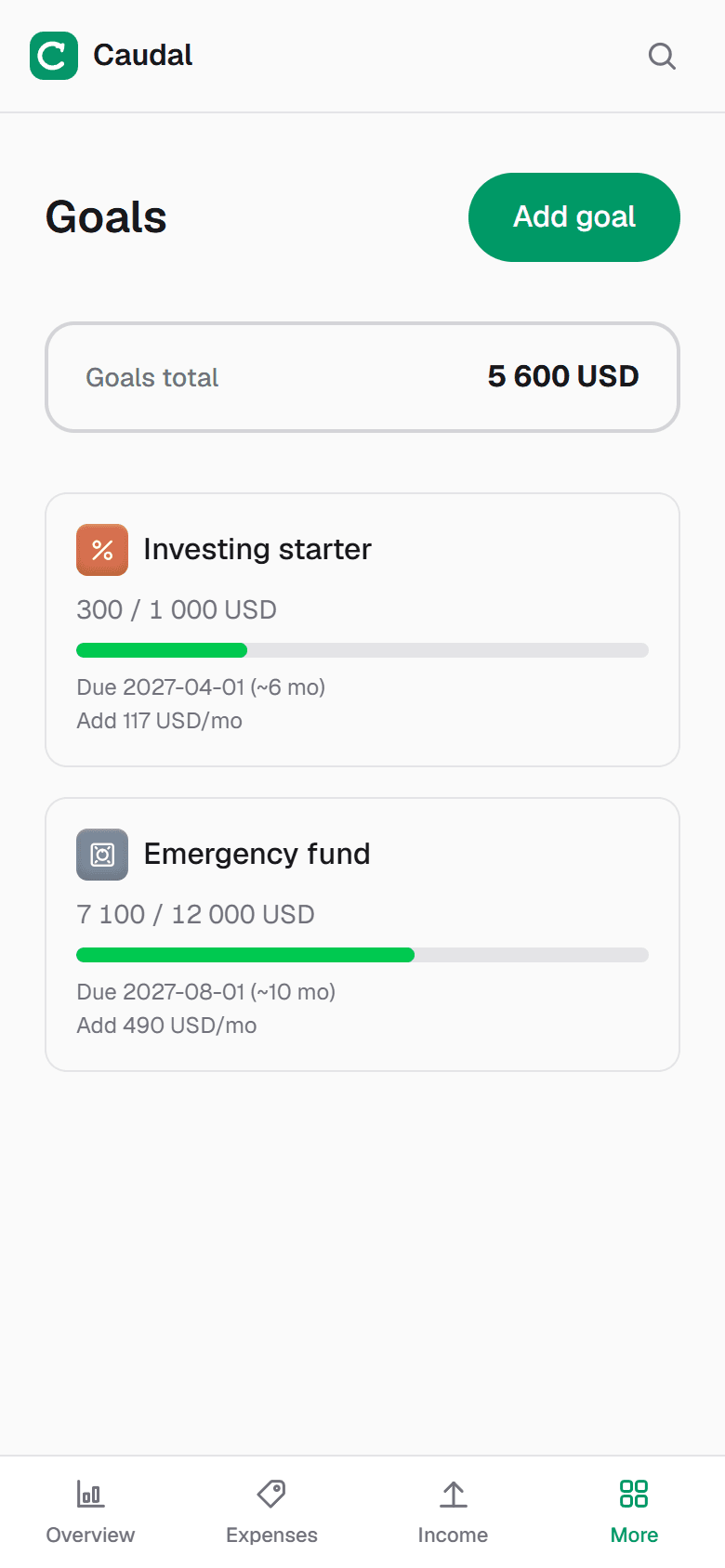
In Caudal you can create a goal called "Investing starter": each payday you set aside what you plan to invest and watch it build. Your emergency fund has a goal of its own, so the money for surprises and the money for the long run never mix.
Common questions
- How much money do I need to start investing?
- Many brokers have no minimum, and Treasury bills start at 100 dollars. What matters more than the first amount is investing a fixed sum every month for years.
- Should I save or invest first?
- Both, in order. First an emergency fund you can reach quickly and no expensive debt; then invest what you will not need for several years.
- What is the safest investment for beginners?
- Government bonds and Treasury bills are the safest, and a broad, low-cost index fund is the simplest way to invest in the stock market for the long term. The second grows more and also falls more.
Try it on your own money
Caudal is an expense tracker in Spanish, English and Russian. Several currencies, goals, debts, a shared household budget. Recording an expense takes three seconds.
Start free