Debt collectors calling? What to do and what not to
A collector's call is frightening, and the whole conversation leans on that fear. A calm order of steps changes its tone.
In short
If debt collectors call, agree to nothing on the phone: ask for the agency's name, the account number and a written notice showing who owns the debt and how the amount was calculated. Check the debt is yours and not too old to be enforced. Pay only through channels you can verify with the original lender, never to a personal account. Threats, late-night calls and discussing your debt with family or your employer are prohibited in most countries — report them to the regulator.
A debt collector is a company a lender hired to recover a debt, or one that bought the debt outright. Its job is to get paid quickly, so the conversation is built on urgency: «today or we go to court». It is almost never as urgent as it sounds.
What to ask on the first call
- The agency's name and the caller's name.
- Whose debt it originally was: lender, account number, date.
- The amount: how much is principal, how much interest and fees.
- Whether they own the debt or are collecting on the lender's behalf.
Write down the answers and the date. Confirm and promise nothing until you have seen documents.
Check the debt is yours
Ask for a written notice of the debt and a breakdown of the amount. Compare it with what you remember: payments that are missing, an amount that looks wrong. If the debt is old, check the statute of limitations where you live. Careful: a partial payment or a written acknowledgement can restart that clock in many places.
What collectors generally may not do
Threaten
Violence, arrest, jail for debt
Prohibited almost everywhere
Call at night
There are permitted hours
In the US, 8 am to 9 pm
Call endlessly
Repeated calls can be harassment
Grounds for a complaint
Tell others
Family, employer, neighbours
Not without your consent
The exact rules depend on the country. In the United States the Fair Debt Collection Practices Act requires a validation notice, gives you thirty days to dispute the debt in writing and limits when and how collectors may contact you; complaints go to the Consumer Financial Protection Bureau. Elsewhere, your financial regulator is the place to report harassment.
How not to pay a scammer
Scammers pose as collectors, chasing debts that do not exist. Warning signs: they ask for payment by gift card, wire or a transfer to a personal account, will not give the agency's name, push a «final day». Pay only through details you can confirm with the original lender, and keep the receipt.
How to settle
If the debt is yours, the collector also wants to close it without court. You can offer a payment plan that fits your budget, or a single lump sum below the full balance. Any agreement only in writing, with the amount and dates. If there are several debts and not enough money, start with the list and priorities: can't pay your loans.
How it looks in the app
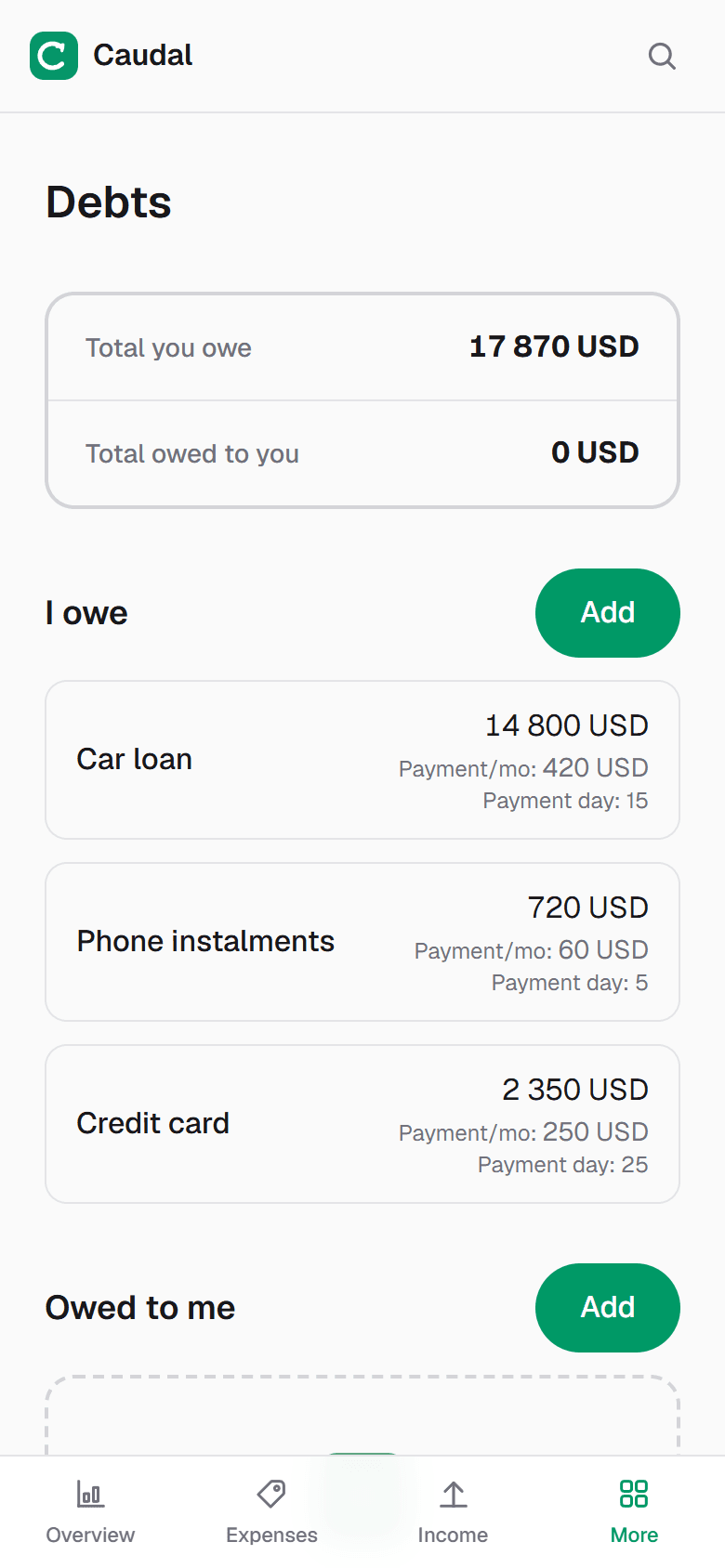
In Caudal a debt that went to collections goes under «Debts» with the agreed amount, monthly payment and day of the month. Each payment is recorded with «Make a payment», the balance updates itself, and the payments appear in the forecast of how long your money lasts on the main screen — so you can check an agreement fits your budget before you sign it. A dated plan for every debt: pay off all your debt in a year.
Common questions
- Can I refuse to talk to debt collectors?
- You can refuse to discuss the debt by phone and ask for everything in writing; in the US you can also ask a collector in writing to stop contacting you. But the debt does not disappear: if it is yours, a payment plan you can keep is usually better.
- What should I do if a debt collector threatens me?
- Note the date, time, number and what was said, and record the call if the law allows. Threats are prohibited almost everywhere: report them to the regulator — in the US, the Consumer Financial Protection Bureau — and to the police if violence was threatened.
- Do I have to pay a debt that went to collections?
- If it is yours and not past the statute of limitations, the obligation remains. But pay only after you have the amount in writing, and only through channels you can verify with the original lender, never to a personal account.
Try it on your own money
Caudal is an expense tracker in Spanish, English and Russian. Several currencies, goals, debts, a shared household budget. Recording an expense takes three seconds.
Start free