Zero-based budget: give every dollar a job
Money without a job spends itself. A zero-based budget simply leaves none of it.
In short
A zero-based budget gives every unit of income a job in advance: income minus spending, saving and debt payments must equal zero. Zero does not mean spending it all — saving is a job too. It is drawn up before the month starts, and when a category runs out, money is moved from another category rather than added from nowhere.
An ordinary budget answers «how much did I spend». A zero-based budget answers in advance: where every part of the income will go. The method began in companies, where costs are justified from scratch every year, but in personal finance it stuck as the strictest and clearest approach.
How it works
Income − (spending + saving + debt) = 0.
Not «what is left over» but «where does it all go». Money without a job disappears on small things; a zero-based budget leaves none.
Example
Income of 4 000.
1 400
Housing and utilities
Essential
800
Groceries
Monthly limit
320
Transport and phone
Essential
400
Eating out, fun
Limit
280
Miscellaneous and gifts
The month's buffer
600
Saving
Emergency fund and goals
200
Extra debt payment
On top of the minimum
0
Left over
Every dollar has a job
How to build it, step by step
- Write down the income that will arrive this month — the real figure, not the hoped-for one.
- List the essentials: housing, loans, phone.
- Assign savings and extra debt payments — before fun, not after.
- Split what remains across flexible categories.
- Check: all the lines add up to the income.
When a category runs out
Move money from another category — and decide which. If groceries go over, the difference comes from eating out or miscellaneous, not «from somewhere». That decision is what makes the method work: overspending becomes a choice instead of a surprise.
Pros and cons
- Pro: every decision is visible, no money goes missing.
- Pro: saving is a line, not a leftover.
- Con: it takes time at the start of each month.
- Con: with irregular income you assign money as it arrives — more in budgeting with variable income.
A similar idea without a spreadsheet: the envelope method, where each envelope is a category and an empty one is not refilled from thin air.
How it looks in the app
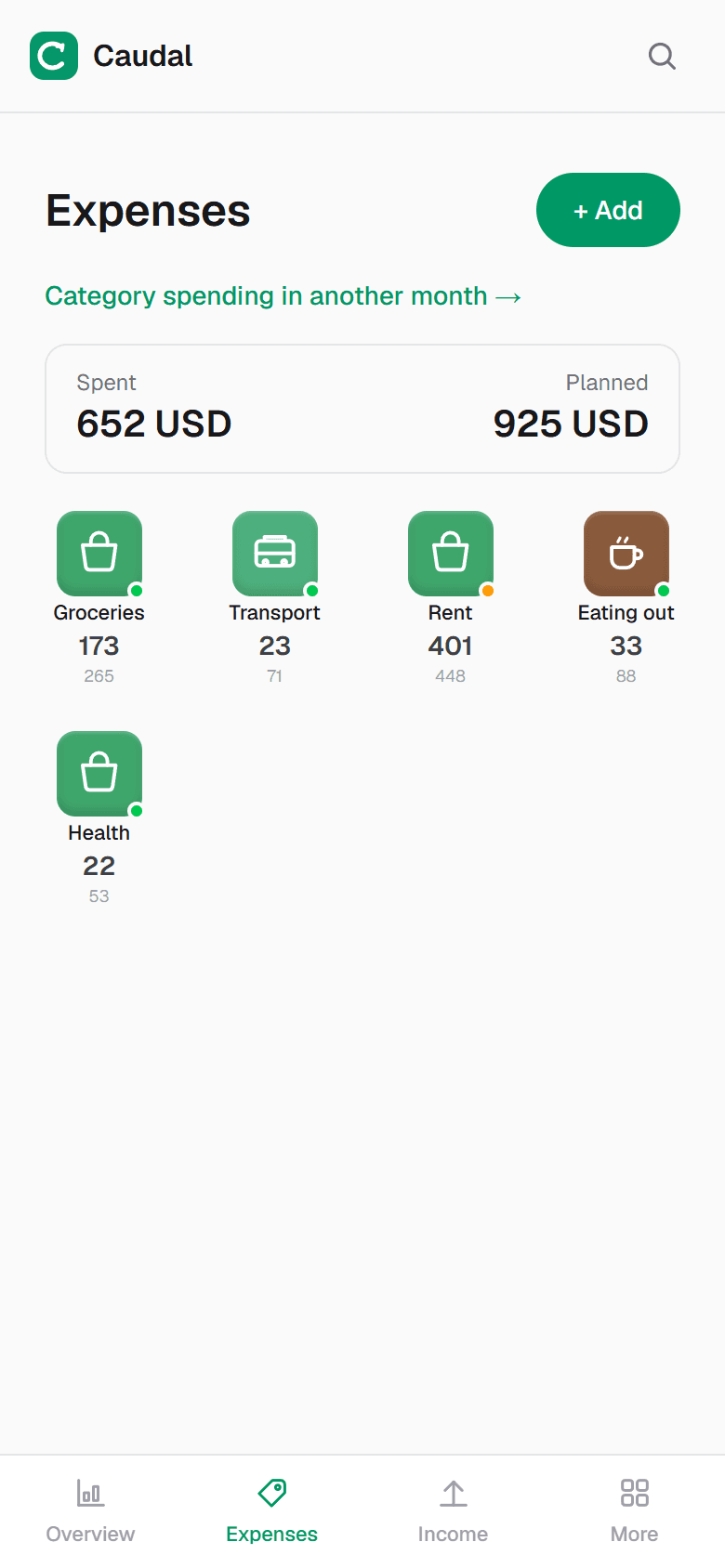
In Caudal a zero-based budget is assembled from what is already there: essential payments under «Recurring», saving as goal contributions, flexible categories with a monthly limit. The app shows how much of each limit is left, and the main screen shows what you can spend today with everything essential and saved already taken off.
Common questions
- Does a zero-based budget mean spending all my money?
- No. Zero means every amount has a job, and saving and extra debt payments are jobs too. They are usually assigned first, before fun.
- How is a zero-based budget different from 50/30/20?
- 50/30/20 sets proportions; a zero-based budget sets a specific amount for every line. They combine well: use the proportions as a guide and assign income down to zero across your own categories.
- What if a category runs out of money?
- Move money from another category and decide which. Adding from nowhere is not allowed — the lines would then exceed income and the budget would stop telling the truth.
Try it on your own money
Caudal is an expense tracker in Spanish, English and Russian. Several currencies, goals, debts, a shared household budget. Recording an expense takes three seconds.
Start free