What is a savings circle and how does it work
A savings circle is saving as a group: everyone pays in each week, and each week one person takes it all.
In short
In a savings circle, a group puts in the same amount every week or month, and each round one member receives the whole pot. With ten people putting in 100 dollars, each round pays out 1,000. Whoever goes first gets an interest-free loan; whoever goes last has simply saved, without interest. The main risk is someone stopping payments after they collect, and there is no contract to protect the others.
Savings circles go by many names: tanda in Mexico, susu in West Africa and the Caribbean, hui in Chinese communities, chit fund in India. Economists call them ROSCAs, rotating savings and credit associations. They all work because letting the group down is uncomfortable.
How it works
10 people
Each puts in 100 dollars a round
One organizer collects
1,000 dollars
Paid to one member each round
In an agreed or drawn order
10 rounds
Length of the circle
Until everyone has collected once
Nobody gains or loses money: everyone puts in 1,000 and everyone gets 1,000. What changes is when.
Which turn suits you
- Early turns are an interest-free loan: you get it all now and repay over the next rounds. Useful for a specific, near expense.
- Late turns are pure saving: you pay in each round and collect at the end. A way to save for people who struggle to do it alone, though without interest.
The risks
- Someone collects and stops paying. The last turns lose.
- The organizer disappears with the money. It happens, especially with strangers or circles organized online.
- Inflation: 1,000 dollars at the end buys a little less than at the start.
Join only with people you know and an organizer you trust. An online "circle" that promises to pay out more than you put in is a scheme, not a savings circle.
The same circle, without relying on anyone
If what works for you is the weekly commitment, run a circle of one: set aside the same amount every week into a goal with a date. You reach the same sum without the risk of someone dropping out, and in a savings account that pays interest, with a little extra: 52-week savings challenge.
How it looks in the app
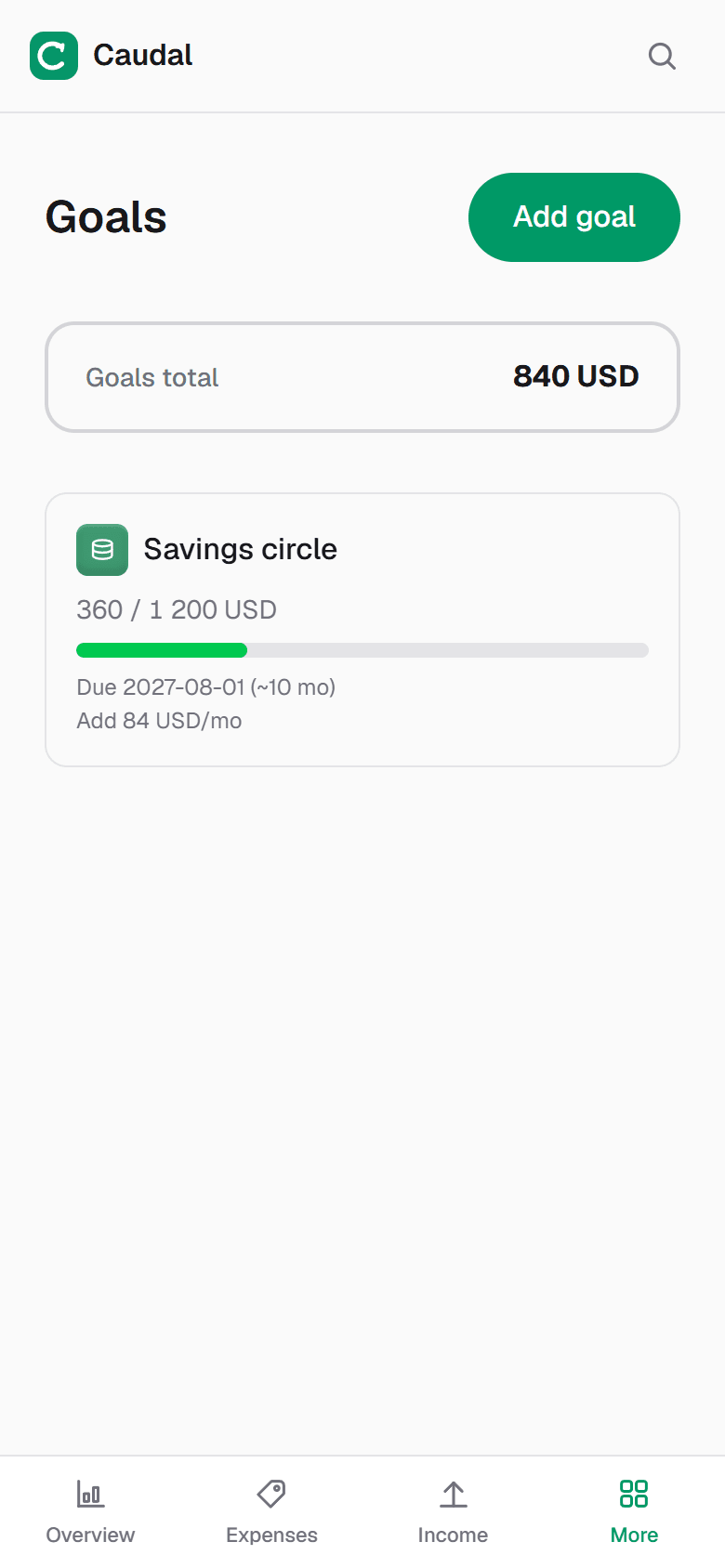
In Caudal you create a goal with the amount and date of your own circle and add to it every week. The app tells you how much to put in each month to make it on time and shows the bar moving, like waiting for your turn, without the turn.
Common questions
- How does a savings circle work?
- Members contribute the same amount every week or month, and each round one member receives the full pot. It lasts as many rounds as there are members, until everyone has collected once.
- Which turn is best in a savings circle?
- An early turn if you need the money soon, since it works like an interest-free loan. A late one if you want to save, though late turns carry the most risk if someone stops paying.
- Are savings circles legal?
- Informal savings circles among people who know each other are generally legal, but they have no contract or protection. Ones that promise to pay out more than members put in are usually pyramid schemes.
Try it on your own money
Caudal is an expense tracker in Spanish, English and Russian. Several currencies, goals, debts, a shared household budget. Recording an expense takes three seconds.
Start free