Wedding budget: how to plan it without debt
A wedding budget does not grow from one big cost but from dozens of small «while we are at it» decisions.
In short
A wedding budget starts from the total, not from a wish list: first decide how much you can spend, then split it. The venue and catering usually take the most, and they multiply with the guest count, so the guest list is the main lever. Set aside ten percent for surprises, divide the amount by the months left and do not borrow for a single day.
A wedding gets expensive not from one line but from how many lines there are. Each cost looks reasonable on its own, and the total ends up half as much again as planned. The defence: the total first, then the split.
Step 1. The total
Add what you already have, what you can save each month until the date and what family will contribute, if they will. That is the budget. Anything beyond it is debt or a later date.
Step 2. Where it goes
Venue and catering
Hire, food, drinks
Often around half the budget
Outfits
Dress, suit, shoes, hair
Often 10–15 percent
Photo and video
Shoot, editing
The cost that lasts longest
Music and host
DJ, band, emcee
Optional
Decoration
Flowers, centrepieces, cake
Grows easily
Licence and extras
Fees, rings, invitations, transport
Adds up unnoticed
Buffer
About 10 percent
For whatever comes up
The guest list is the lever
Catering is charged per head, and with it grow the venue, the tables, favours and transport. Twenty fewer guests is a saving no discount will match. Write the list, then ask: which of these people did we see in the last year?
Step 3. How much to save each month
The amount you need minus what you have, divided by the months left. With a year to go and 12 000 missing, that is 1 000 a month. If it does not fit the budget, better to know now. The full calculation for any big purchase: how much to save each month for a big purchase.
Where to cut without losing anything
- An off-season date that is not a Friday or Saturday.
- Fewer guests rather than cheaper food.
- One good photographer rather than photo, video and drone done halfway.
- Renting outfits or buying second-hand.
What not to do
Do not take a loan for the wedding. The party lasts a day and the payments years, and starting married life with a shared debt is a common cause of money arguments. And do not count on cash gifts to cover costs in advance: their total cannot be predicted.
How it looks in the app
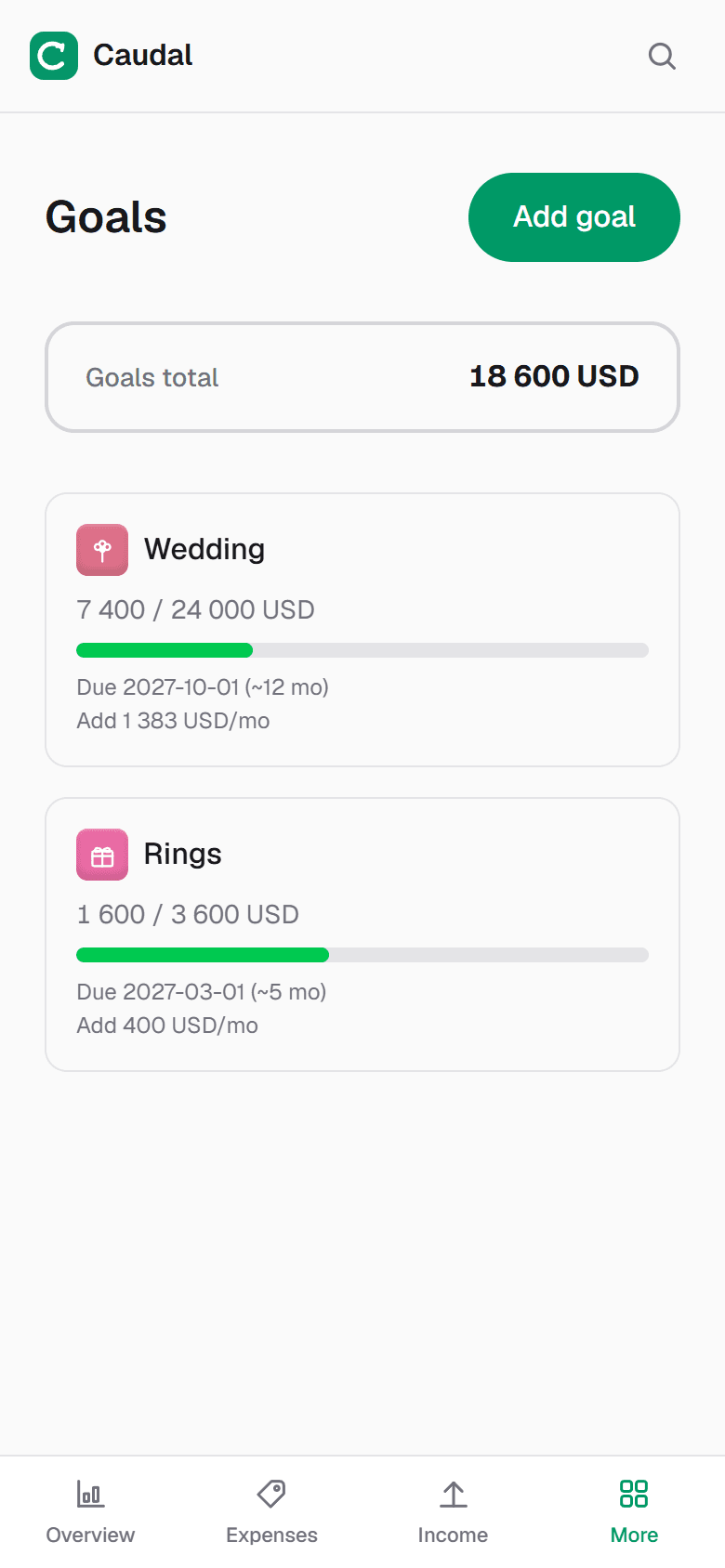
In Caudal create a «Wedding» goal with an amount and a date: the app works out how much to set aside each month and recalculates after every contribution. If you save as a couple, both of you see the shared budget and every contribution counts towards the goal. Wedding costs are easiest to track in their own category with subcategories — venue, outfits, photos — so you see which line went over while there is still time to rebalance. How to run money together afterwards: budgeting as a couple.
Common questions
- How much does a wedding cost?
- It depends on the city, the season and, above all, the guest count: venue and catering are often around half the budget and are charged per head. Work backwards — how much you can save by the date — and split that sum across the categories.
- What takes most of the money at a wedding?
- Usually the venue and catering: food and drink per guest and the hire of the space. Then outfits, photo and video, and decoration. That is why trimming the guest list saves more than any single discount.
- Should we take a loan for the wedding?
- Better not: the party lasts a day and the payments years. If the money is short, it is healthier to cut the guest list or move the date and keep saving than to start married life in debt.
Try it on your own money
Caudal is an expense tracker in Spanish, English and Russian. Several currencies, goals, debts, a shared household budget. Recording an expense takes three seconds.
Start free