How to track spending on a trip abroad without losing the thread
You pay 50 in the local currency, the notification talks to you in dollars, and a third figure leaves your account that nobody mentions.
In short
On a trip, always record the amount on the receipt, in the currency you paid in: it is the only figure that will not change. What actually leaves your account arrives later and rarely matches the market rate, because it carries the card's margin and sometimes a separate fee. Reconcile when you get home by comparing the real account balance with the one you have recorded, and adjust once.
A trip is the only time three currencies take part in one purchase: the country's, your account's, and the one your bank uses internally to get from one to the other. Each gives a different number, and only one of the three is on the receipt.
The three numbers in one purchase abroad
What you paid
The receipt
In the country's currency, and the only figure that never changes
What you were told
The notification
Usually dollars or euros: the card's internal conversion
What left
Your account
Arrives hours or days later, with the margin and fees inside
Record the receipt, not the conversion
The rule that saves the whole trip: the amount on the receipt, in the currency of the receipt. It is the only one of the three that depends on nobody, and the only one that will still be true in a year.
Conversions can be recalculated later. The receipt, if you did not record it, is gone: nobody remembers exactly what that dinner cost.
Why your card's rate is not the market rate
Because it was never meant to be. Between what a search engine shows and what is applied to your purchase there is usually a margin of 1 to 4%, and sometimes a foreign-transaction fee on top.
That is not a scam, it is the price of the service, but it has a practical consequence: if you convert your spending at the market rate, your trip will come out systematically cheaper in your records than in your bank account. Always in the same direction, never cancelling out.
And the worst of all: the rate on the card terminal
When the terminal asks whether you would rather pay in your own currency instead of the local one, the right answer is almost always the local one. That helpful-looking option is called dynamic currency conversion, and it applies a rate chosen by the merchant, usually 3 to 7% worse than your own card's.
It is the best effort-to-money travel tip there is: one tap on the correct button.
How to reconcile afterwards
There is no need to chase every purchase. It is done once:
- Look at the real balance of the account you paid with.
- Compare it to the one you recorded. The difference is the sum of every margin and fee on the trip.
- Adjust it in one go, with a balance correction dated the day you got back.
What is left is a trip recorded with true receipts and a balance that matches reality. Which is exactly what is needed: the category figures answer what travelling costs, and the balance answers what you have left.
Cash goes in an account of its own
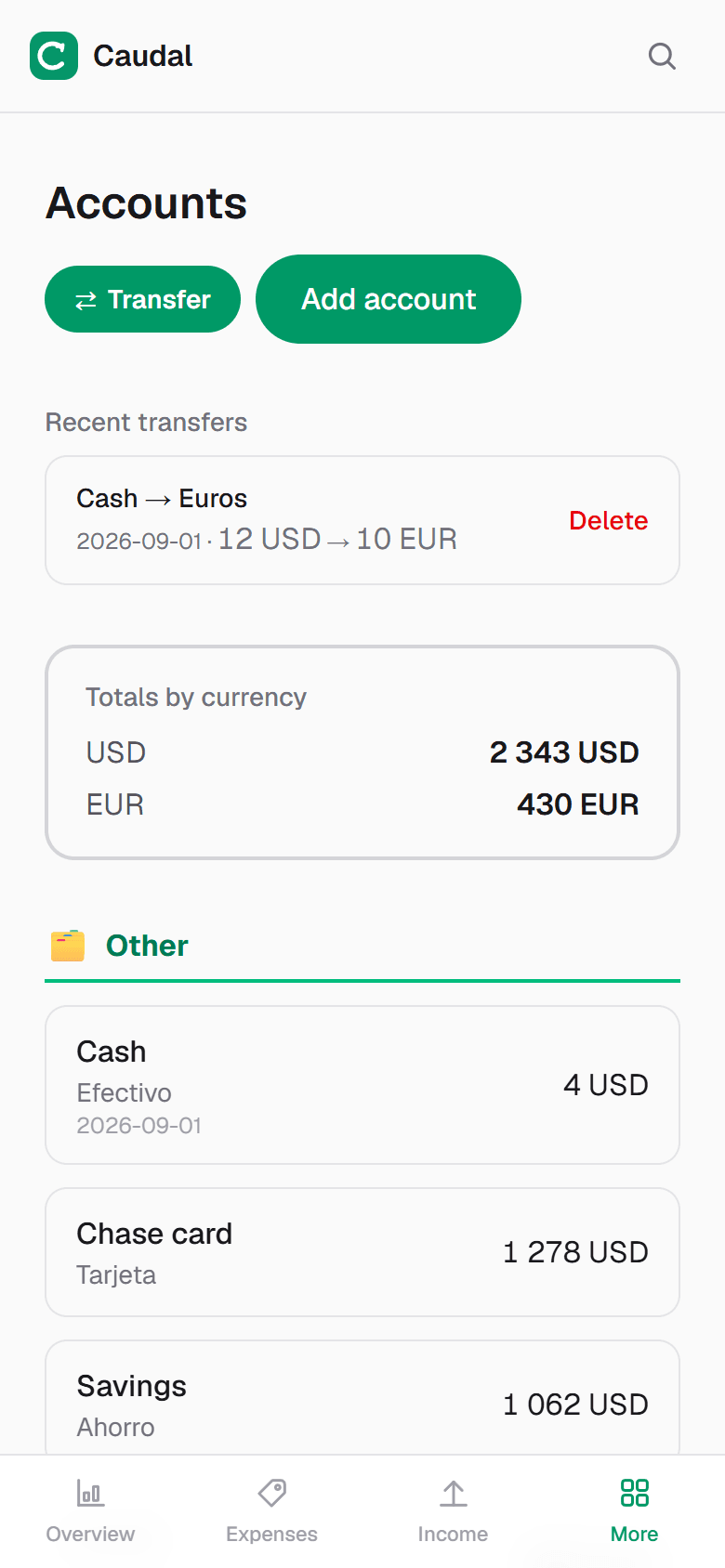
If you change money on arrival, treat it as another account in that currency: the exchange is a transfer, not an expense, and purchases come out of it. That way the day you change money does not appear as an enormous spend that never happened. It is explained in how to track cash spending.
Common questions
- Which currency should I record a travel expense in?
- The receipt's, always. It is the only one of the three figures that will not change afterwards, and the only one you cannot recover if you do not record it at the time.
- Should I pay in the local currency or my own when the terminal asks?
- The local one, almost always. Choosing your own currency triggers dynamic currency conversion, at a rate the merchant picks, usually 3 to 7% worse than your card's.
- How do I find the real rate I was charged?
- Divide what left your account by what the receipt said, once the charge settles. That is your real rate, margin and fees included, and it is usually 1 to 4% worse than the market one.
Try it on your own money
Caudal is an expense tracker in Spanish, English and Russian. Several currencies, goals, debts, a shared household budget. Recording an expense takes three seconds.
Start free