Rent or buy a home? How to work out which is better
«Rent is money thrown away» sounds convincing until you work out how much of a mortgage payment is interest.
In short
To decide between renting and buying, do not compare the mortgage payment with the rent: compare the costs you never get back — interest, insurance, property tax and upkeep — against the rent. Count, too, that a down payment locked in the house stops earning a return. If the price is more than twenty years of rent, renting and saving often wins; if it is less than fifteen, buying usually does.
«Rent or buy» is rarely only about money: your own home is also stability, decorating as you like, no more moving. But the financial part can be calculated, and sometimes the result surprises.
What to compare
Not the mortgage payment with the rent: part of the payment repays the loan — your own money, which stays in the house. What to compare are the unrecoverable costs, the money gone either way.
Renting
The rent
Almost all of it is gone
Buying
Interest to the bank
Especially in the early years
Buying
Insurance, property tax
Every year
Buying
Maintenance and repairs
Often about one percent of the value a year
Buying
Lost return on the down payment
Money in bricks earns no interest
The price-to-rent ratio
Divide the home's price by a year's rent for a similar home. Below fifteen, buying usually wins. Above twenty, rent and invest the difference. In between, the rate, the term and your plans decide.
Example: a home costs 360 000 and a similar one rents for 1 800 a month, 21 600 a year. The ratio is almost seventeen: the answer depends on the mortgage rate and how many years you plan to stay in that city.
When buying makes sense
- Rates are low and rent is high relative to price.
- You plan to stay a long time — seven to ten years or more.
- The payment is no more than a third of income and an emergency fund remains.
When renting and saving makes sense
- Rates are high, and the early years' interest exceeds the rent.
- You are unsure about the city, the job or who will live with you.
- The down payment would take your whole emergency fund.
If you save, do it with an amount and a date: how to save for a house.
What else to count
Buying brings one-off costs: inspection, closing costs, fees, the move, furniture. And risk: if income falls, a rental can be swapped for a cheaper one; a mortgage payment stays the same. Before deciding, work out your debt load with the future payment: debt-to-income ratio.
How it looks in the app
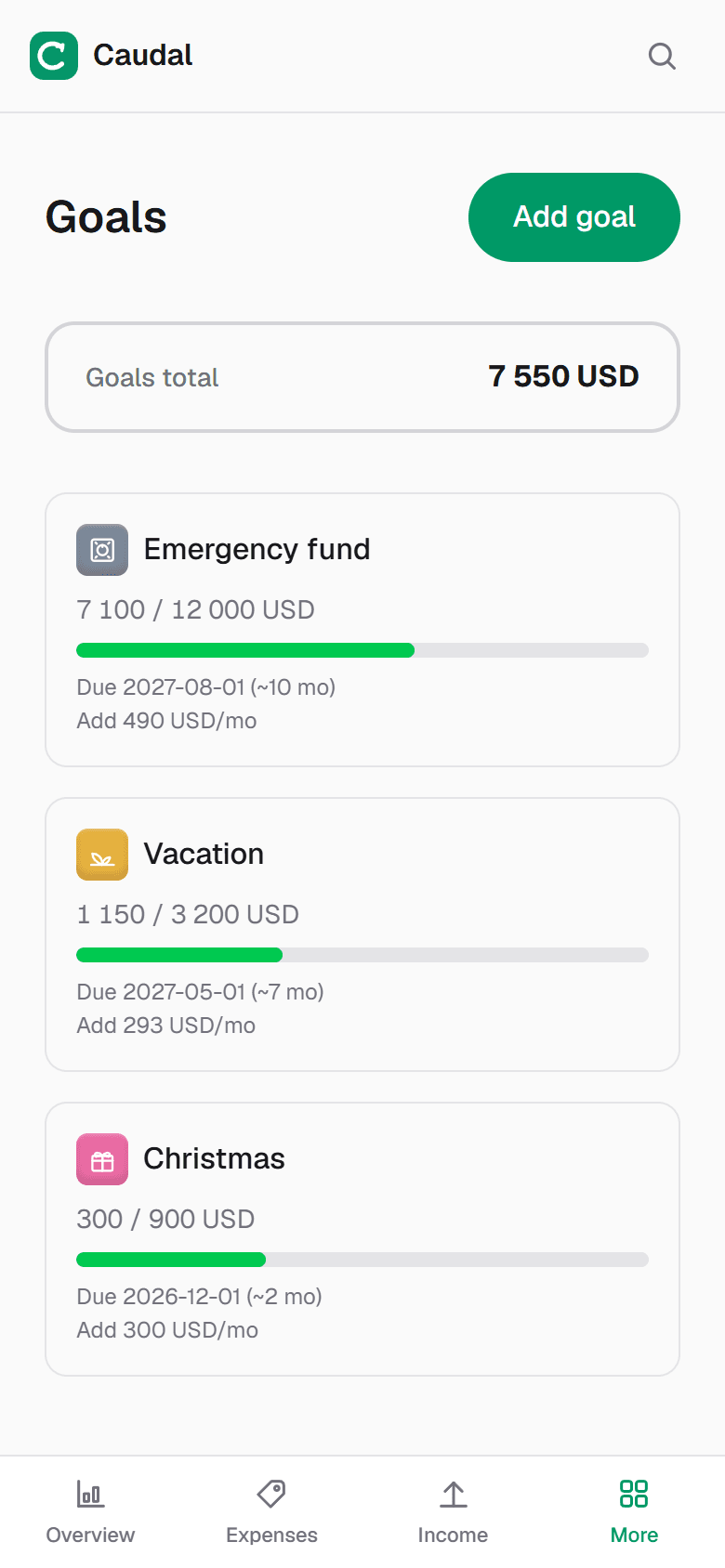
In Caudal saving for a down payment is a goal with an amount and a date: the app works out how much to set aside each month. To test whether you can carry a mortgage, spend a few months putting the difference between the future payment and your current rent into that goal: if it works without slips, the budget will hold. And once you have the mortgage, it goes under «Debts» with its payment and day of the month, and enters the forecast of how long your money lasts on the main screen.
Common questions
- Is it better to rent or buy a home?
- It depends on the price-to-rent ratio, the rate and how long you stay. If the home costs more than twenty years of rent, renting and investing the difference often wins; below fifteen, buying usually does. Compare unrecoverable costs, not the payment with the rent.
- Is renting throwing money away?
- No more than mortgage interest, insurance and upkeep, which are also gone for good. In the early years of a mortgage most of the payment is interest, and sometimes it exceeds the rent on a similar home.
- How do I know if I can afford a mortgage?
- For a few months, set aside the difference between the future mortgage payment and your current rent. If you manage it without touching the emergency fund, the budget will hold — and you build part of the down payment on the way.
Try it on your own money
Caudal is an expense tracker in Spanish, English and Russian. Several currencies, goals, debts, a shared household budget. Recording an expense takes three seconds.
Start free