How much pocket money to give, and from what age
Pocket money is not a present but practice. Getting it wrong with a small sum at eight is cheaper than with a salary at twenty.
In short
An allowance usually starts at six or seven, when a child can count and understands that money runs out. Younger children do best with a small sum weekly; teenagers with a monthly amount, so they learn to plan. The amount follows what the child pays for: if it covers school lunches it is larger than if it is for sweets. The key rule is not to top it up when it runs out early.
Pocket money teaches what talks do not: money runs out, choosing one thing means giving up another, and what you put aside today becomes a bigger purchase next month.
From what age
6–7
A small sum weekly
Can count, understands «gone»
8–11
Weekly, a bit more
First savings for a goal
12–14
Fortnightly or monthly
Learns to make it last
15–17
Monthly, with own costs
Phone, transport, clothes
How much to give
There is no universal amount: it depends on family income and on what the child buys. The practical way is to agree which costs they are responsible for:
- only treats — sweets, stickers, games;
- plus something regular — school snacks, bus fare;
- for a teenager — some clothes, phone, outings with friends.
More responsibility, more money. Work out what you already spend on those things — that is your starting point.
Rules that work
- The same day every time. Regularity matters more than size: the child learns to wait and to plan.
- No top-ups when it is gone. Otherwise the lesson is cancelled. You can lend, repaid from the next allowance.
- Do not take it away as a punishment for grades or behaviour. Money becomes a lever instead of a tool.
- Do not audit every purchase. A bad buy with their own money is the best lesson there is.
Paying for grades or chores?
Ordinary chores are part of living in a family, and paying for them teaches that help comes with a price. Extra work — the kind you would otherwise pay someone for — is different and can be paid separately. Most specialists advise against paying for grades: the reason to learn becomes external.
Teaching them to save
Suggest a goal — a toy or something costing more than one week's money — and work out together how many weeks it takes. Some parents add «interest» for every week saved: the best explanation of compound interest there is. By age: how to teach kids to save money.
How it looks in the app
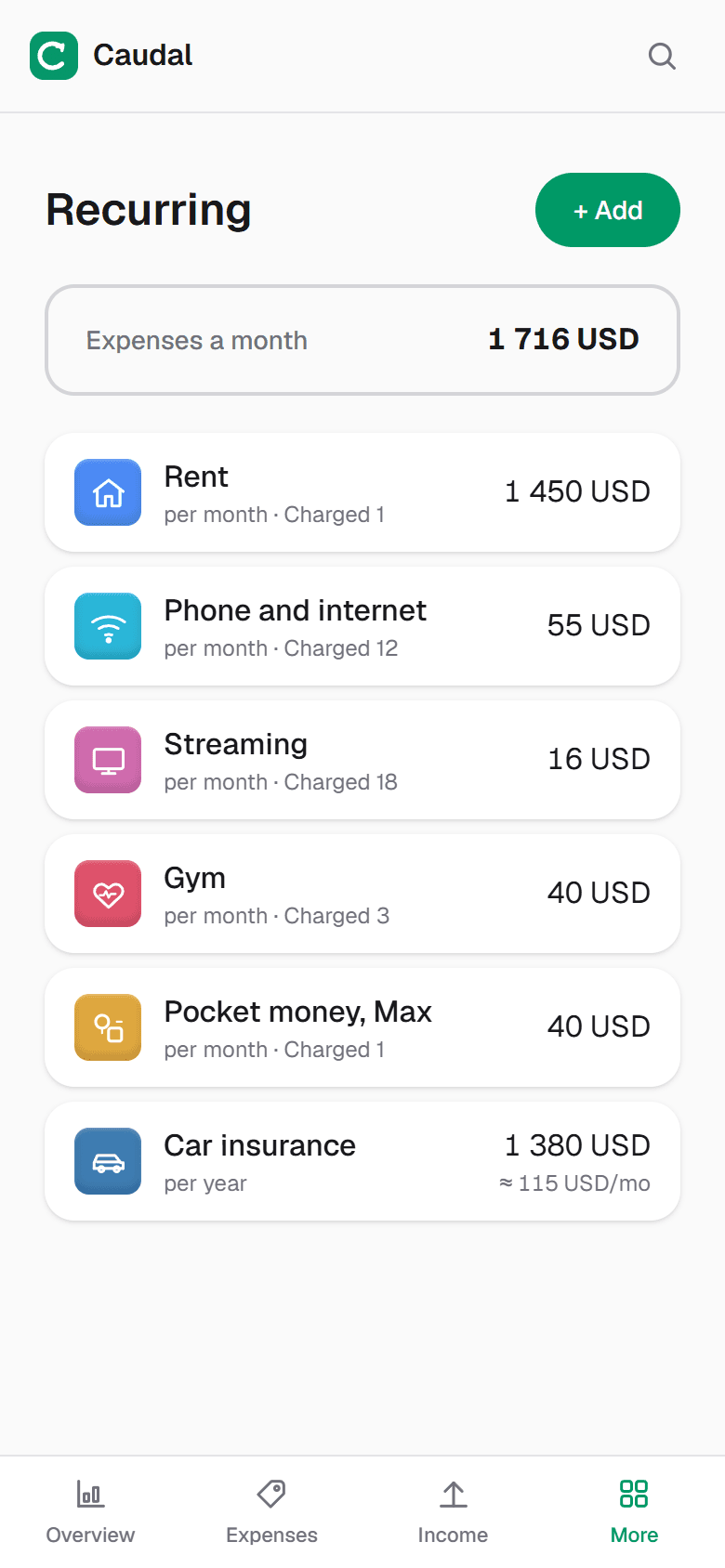
In Caudal pocket money works well as a recurring payment with an amount and a day, so it is not forgotten and shows in the family budget. If a teenager tracks their own spending, you can add them to the family section: you see who spent what and on what, without checking every receipt. The child's goal — a pot with an amount and a date — goes under «Goals», and the app shows how much to save each week.
Common questions
- At what age should children get pocket money?
- Usually from six or seven, when they can count and understand that money can only be spent once. It is best to start with a small weekly amount.
- How much pocket money should a teenager get?
- As much as the costs they are responsible for: snacks, transport, phone, part of their clothes and outings. Work out what the family already spends on these and hand over that sum along with the responsibility, once a month.
- Should I pay my child for good grades?
- Most specialists advise against it: studying becomes paid work and interest drops. Paying for extra jobs beyond ordinary household chores is fine.
Try it on your own money
Caudal is an expense tracker in Spanish, English and Russian. Several currencies, goals, debts, a shared household budget. Recording an expense takes three seconds.
Start free